
Quick Answer
Most popular AI meeting assistants include language in their privacy policies that allows them, and their vendors, to use your transcription data to improve their AI models. A few tools offer opt-out mechanisms for paid or enterprise plans. Very few make a contractual commitment that your meetings will never be used for AI training at any tier.
Before connecting any AI meeting tool to your calendar and granting it access to your conversations, it is worth spending five minutes reading what they actually say about your data.
Key Takeaways
- "We use data to improve our services" is the most common phrase to watch for. It frequently means model training.
- Free plans carry the most risk. Several tools are explicit that free-tier users have fewer data protections than paid users.
- Opt-out is not a contractual guarantee. Being able to opt out of training is not the same as a vendor being contractually prohibited from doing it.
- Your subprocessors matter too. Even if the tool itself does not train on your data, their transcription or AI vendors may.
- KenzNote contractually prohibits both itself and its vendors from using your meeting data for AI training, at every pricing tier.
Table of Contents
- What "Training on Your Data" Actually Means
- How to Read an AI Meeting Tool's Privacy Policy
- Otter.ai
- Fireflies.ai
- tl;dv
- Fathom
- Read.ai
- The Comparison at a Glance
- What KenzNote Does Differently
- 5 Questions to Ask Before You Sign Up
- Frequently Asked Questions
Picture this: your sales rep closes the biggest deal of the quarter. The entire customer conversation, the pricing discussion, the objections, the relationship nuance, lives inside a meeting transcript in your AI notetaker's cloud. Somewhere in that tool's terms of service, a clause quietly authorizes using that conversation to train the next generation of its AI model.
This is not hypothetical. It is how several leading AI meeting tools are built.
The meeting productivity software market is growing fast, and AI training data is valuable. When a vendor gives you a free or heavily subsidized tool and charges you almost nothing for transcription, it is worth asking: how are they actually funding the product?
Here is what each major tool actually says.
What "Training on Your Data" Actually Means
When AI companies refer to training on user data, they mean using recordings, transcripts, or derived outputs (summaries, action items, speaker labels) as input data to fine-tune or retrain their machine learning models.
The result is a better product for future users. The cost is that your private business conversations become part of a shared training dataset.
This matters differently depending on who you are:
- For legal teams: Attorney-client privileged conversations cannot safely sit in an AI training corpus.
- For sales teams: Competitive pricing discussions, deal terms, and customer objections are proprietary.
- For HR teams: Performance discussions, compensation data, and candidate assessments carry legal exposure.
- For executives: Board discussions and M&A strategy conversations are strictly confidential.
Even for everyday users, the idea that your conversations with your team are quietly improving a vendor's AI product, without explicit consent, is a reasonable thing to object to.
 Privacy controls in AI meeting tools vary significantly across vendors and pricing tiers.
How to Read an AI Meeting Tool's Privacy Policy
When reviewing any AI meeting tool's privacy policy, look specifically for these phrases:
- "Improve our services" or "improve our products": often the broadest data use permission, and frequently includes model training.
- "Machine learning" or "train our AI": explicit confirmation that model training is in scope.
- "Aggregate and anonymize": anonymization is not the same as deletion. Anonymized transcripts can still be used to train models.
- "Opt out": the presence of an opt-out means training is the default, not the exception.
- "Enterprise plan": many tools only offer strong data protections at their top tier, leaving individual and business plan users exposed.
Now let us look at what each major tool actually says.
Otter.ai
Otter.ai's privacy policy states that it may use customer data to improve and develop its services, which includes training and improving AI models. The key distinction is between plan tiers: enterprise customers can negotiate data processing agreements (DPAs) that restrict this use. Individual and business plan users have fewer protections.
Otter also has a notable data access model: its default integration requires connecting your Google or Microsoft calendar, and in some configurations the platform reads email and calendar content to enhance transcriptions. For users who have not reviewed these permissions carefully, the scope of data access can be broader than expected.
Data training stance: Training on user data allowed by default on non-enterprise plans; enterprise DPA required for restriction.
Fireflies.ai
Fireflies.ai's privacy policy includes language that permits using your data to improve the Fireflies platform. This includes transcript data processed through the service. Like Otter, Fireflies offers enterprise agreements with stricter data handling terms, but the default position for free and Pro plan users does not carry the same restrictions.
Fireflies also relies on a network of third-party subprocessors for transcription and AI inference. Whether those subprocessors are contractually bound to the same standards as Fireflies itself is not made clearly explicit in their public documentation.
Data training stance: Service improvement permitted; stronger protections available at enterprise tier only.
tl;dv
tl;dv's privacy policy takes a slightly more explicit approach, distinguishing between data used to provide the service and data used to improve it. They state that aggregated and anonymized data may be used to improve product features and AI capabilities.
"Anonymized" data is not the same as deleted data, and anonymization processes can sometimes be reversed, particularly for specific or distinctive transcripts. tl;dv's enterprise customers can enter into custom DPAs, but standard plan users operate under the default terms.
Data training stance: Anonymized and aggregated data may be used to improve AI; enterprise DPA available.
Fathom
Fathom is often recommended as a free alternative to paid meeting notetakers. That free positioning makes the data question especially relevant.
Fathom's privacy policy permits using interaction data and aggregated service data to improve its platform. As with other free-tier products, the implicit economics apply: if you are not paying for the product, the data flowing through it may be part of the value exchange. Fathom does not make a public contractual commitment across all tiers prohibiting AI training on meeting content.
For users who are considering Fathom's free plan for client-facing calls or sensitive internal discussions, this is worth weighing carefully.
Data training stance: Service improvement and feature development permitted; no public contractual guarantee prohibiting training.
Read.ai
Read.ai has moved up-market toward enterprise customers and has invested in compliance infrastructure, including international data residency options. Their enterprise offering includes data processing agreements and more restrictive data use terms.
For standard and pro plan users, Read.ai's terms include provisions for using anonymized, aggregated data to improve the platform. Enterprise customers with a signed DPA get stronger protections.
Read.ai also generates behavioral and engagement metrics from your meetings, speaking time, engagement scores, sentiment, which creates an additional category of derived data beyond the transcript itself.
Data training stance: Aggregated and anonymized use permitted at standard tiers; enterprise DPA offers restriction.
The Comparison at a Glance
| Tool | Default Training Permitted | Opt-Out Available | Contractual Prohibition | At Which Tier |
|---|---|---|---|---|
| Otter.ai | Yes | Enterprise DPA only | No (standard) / Yes (enterprise) | Enterprise only |
| Fireflies.ai | Yes | Enterprise DPA only | No (standard) / Yes (enterprise) | Enterprise only |
| tl;dv | Anonymized/aggregated | Enterprise DPA | No (standard) / Negotiable (enterprise) | Enterprise only |
| Fathom | Yes | Not publicly documented | No | N/A |
| Read.ai | Anonymized/aggregated | Enterprise DPA | No (standard) / Yes (enterprise) | Enterprise only |
| KenzNote | No | N/A | Yes, all tiers | Every plan |
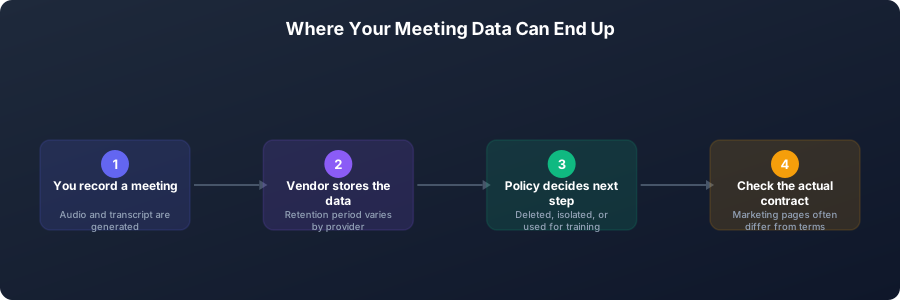 The path your recording takes after the call ends depends entirely on the vendor policy in place.
Policies reviewed May 2026. Always verify the current policy directly on each vendor's website, as terms change.
What KenzNote Does Differently
KenzNote's position is simple and unconditional: your meeting data belongs to you, and we never use it to train AI models.
This applies at every pricing tier, free, pay-per-meeting, and subscription. It is not an enterprise-only benefit behind a negotiated DPA. It is the baseline.
More importantly, the commitment extends to vendors. KenzNote's subprocessors, the transcription and AI inference providers that process your audio, are contractually prohibited from using your data for their own model training purposes. This matters because the weakest link in many platforms is not the platform itself; it is the third-party transcription service receiving your raw audio.
 KenzNote includes visual consent indicators and privacy controls on every meeting recording.
KenzNote is also GDPR compliant with built-in consent tooling: visual recording consent indicators, consent logging for compliance purposes, and data subject rights tools for deletion and portability. These are not add-ons for enterprise customers. They are included because privacy-first is a design principle, not a marketing claim.
If you want to verify this before signing up, read the KenzNote Privacy Policy. The language is direct and does not require a legal team to interpret.
5 Questions to Ask Before You Sign Up
Before connecting any AI meeting tool to your calendar and your calls, ask these five questions:
1. Does your privacy policy explicitly state that meeting recordings and transcripts are never used to train AI models? Look for direct language, not vague "we protect your data" assurances.
2. Does this commitment extend to your subprocessors? Your audio passes through a transcription service before it becomes text. Ask whether that provider is also bound by training prohibitions.
3. Do I need an enterprise plan to get meaningful data protections? If yes, understand that your free or standard-tier meetings are operating under weaker terms.
4. What happens to my data if I cancel? Review the data retention policy. How long does the vendor keep your recordings and transcripts after account termination?
5. Is there an opt-out or a contractual prohibition? An opt-out means training is the default. A contractual prohibition means it is not permitted at all. These are meaningfully different.
Frequently Asked Questions
Do all AI meeting tools train on user data?
Not all of them. Most leading tools include language that permits using your data to improve their services, which can include model training. The extent varies: some restrict this to anonymized, aggregated data; others apply it more broadly. KenzNote is among the few that contractually prohibits training on your data at every pricing tier.
What is the difference between "improving the service" and "training AI models"?
In practice, they often overlap. Training machine learning models on real-world transcription data is how AI companies improve transcription accuracy, summary quality, and action item extraction. When a tool says it uses data to improve its services, model training is typically within scope unless the policy explicitly says otherwise.
Can free AI meeting tools be trusted with confidential conversations?
This depends on the tool. For business-critical conversations, client calls, financial discussions, HR matters, legal consultations, you should review the privacy policy before using any tool, paid or free. Several free tools have terms that permit broader data use than their paid counterparts. When in doubt, choose a tool with a clear, documented no-training policy.
What is a Data Processing Agreement (DPA) and do I need one?
A DPA is a contract between you and a vendor that specifies how your personal data is handled, stored, and used. Under GDPR, a DPA is required when you use a third-party processor that handles personal data. For enterprise users, DPAs with strict data use limitations are the standard way to restrict AI training. If you are not on an enterprise plan with a signed DPA, your data is typically governed by the vendor's standard terms.
Does anonymizing meeting data make it safe to use for AI training?
Anonymization reduces privacy risk but does not eliminate it. Anonymized transcripts can sometimes be re-identified through unique phrasing, context, or distinctive discussion topics. For highly sensitive conversations, "anonymized" is not an equivalent to "your data will never be used."
How do I know KenzNote will not change its privacy policy in the future?
KenzNote's privacy-first commitment is a core product principle, not a feature flag. You can review the current KenzNote Privacy Policy at any time. As with any vendor, we recommend bookmarking the policy page and reviewing it when you receive update notifications.
Related Resources
References & Citations
- [1]
All external sources have been reviewed for accuracy and relevance. Last verified: October 2026.

About KenzNote Team
The KenzNote team is dedicated to helping teams capture better meeting insights and transform how they collaborate. With backgrounds in AI, product design, and enterprise software, we're building the future of meeting productivity.
Ready to transform your meetings?
KenzNote automatically captures meeting insights, extracts action items, and generates summaries so you can focus on the conversation instead of taking notes.
Try KenzNote Free