![Board Meeting Minutes Template: 4 Free Downloads + AI Guide [2026]](/images/blog/meeting-minutes-1024w.webp)
Board Meeting Minutes Template: 4 Free Downloads + AI Guide [2026]
Quick Answer
Board meeting minutes are the official legal record of what occurred at a board of directors meeting. They document attendance, motions, votes, and action items. Every corporation, nonprofit, HOA, and advisory board is required to maintain them.
This guide gives you 4 complete, ready-to-use board meeting minutes templates (corporate, nonprofit, small business, and HOA), a step-by-step process for writing accurate minutes, and a look at how AI tools like KenzNote can dramatically reduce the time it takes to get from meeting to finished document.
Legal note: Board meeting minutes serve as official legal records in most jurisdictions. While these templates provide a strong professional foundation, have your organization's legal counsel review your minutes format and retention policy to ensure compliance with applicable law.
Key Takeaways
- 4 free templates included for corporate boards, nonprofits, small business advisory boards, and HOAs
- Minutes are legal documents that protect board members, satisfy regulatory requirements, and can be subpoenaed
- Required elements: date, attendees, quorum confirmation, all motions with exact wording, vote counts, and action items
- Verbatim transcripts are not minutes and can create legal risk by capturing off-the-record remarks
- AI tools like KenzNote reduce drafting time from hours to minutes by transcribing and summarizing meetings automatically
- Draft within 24 hours while discussion context is still fresh
- Minutes must be approved at the next board meeting before becoming official records
- Retention: most jurisdictions require 7+ years; best practice is permanent retention
Table of Contents
- What Are Board Meeting Minutes and Why Do They Matter?
- What Must Be Included
- 4 Free Board Meeting Minutes Templates
- How to Write Board Meeting Minutes
- Common Mistakes to Avoid
- How AI Speeds Up Board Minutes Drafting
- KenzNote Workflow for Board Minutes
- Frequently Asked Questions
- Related Resources
Board meeting minutes are among the most consequential documents your organization produces. They create a legally recognized record of decisions made, motions passed, and votes cast. Yet many boards still struggle with inconsistent documentation, or spend hours drafting minutes that could be completed in a fraction of the time.
This guide gives you everything you need to stop guessing and start documenting with confidence.
What Are Board Meeting Minutes and Why Do They Matter Legally?
Board meeting minutes are the official written record of what occurred during a board of directors meeting. They document attendance, discussions, motions, votes, and action items, creating an authoritative account that can be referenced months or years later.
📊 Fact Box: The Legal Weight of Board Minutes
- All 50 U.S. states require board minutes for nonprofits and corporations
- Up to $10,000 fines for non-compliance plus potential loss of legal protections
- IRS audits: Nonprofits must provide minutes to maintain tax-exempt status
- Discovery requests: Minutes can be subpoenaed in litigation
- Retention period: Most states require 7+ years of minute retention
Sources: National Council of Nonprofits, IRS Nonprofit Guidance
The Legal Weight of Board Minutes
Minutes are not merely administrative paperwork. They carry significant legal and governance implications.
Corporate accountability. For corporations, minutes demonstrate that the board exercised proper oversight and fulfilled its fiduciary duties. In disputes, litigation, audits, or regulatory investigations, minutes serve as primary evidence of how and why decisions were made.
Tax-exempt status. For nonprofit organizations, the IRS and state attorneys general may request minutes to verify that the organization is operating consistently with its stated mission and governance policies.
Liability protection. Well-maintained minutes can protect individual board members from personal liability by establishing that they followed proper procedures, disclosed conflicts of interest, and voted in accordance with their duties.
Corporate formalities. Failing to maintain adequate minutes is one factor courts consider when determining whether to "pierce the corporate veil" and hold shareholders personally liable for corporate obligations.
In short: sloppy minutes are a legal and governance risk. Accurate, complete minutes are a form of organizational protection.
What Must Be Included in Board Meeting Minutes?
While requirements vary by jurisdiction and organization type, professionally prepared board minutes should always include the following elements.
Required Elements
- Date, time, and location of the meeting
- Type of meeting (regular, special, annual, emergency)
- Names of directors present and confirmation of quorum
- Names of directors absent (with or without excuse)
- Names of guests or staff present
- Call to order and confirmation that a quorum exists
- Approval of previous meeting minutes (and any corrections)
- All motions made, including the exact wording, who made the motion, who seconded it, and the outcome (passed/failed/tabled)
- Vote counts where required (yeas, nays, and abstentions)
- Key discussion points summarized, not verbatim transcripts, but enough to reflect the reasoning behind decisions
- Reports received (financial, committee, executive director)
- Action items with assigned responsibility and deadlines
- Time of adjournment
- Signature of the recording secretary (and sometimes the board chair)
What Minutes Should NOT Include
- ❌ Verbatim transcripts of all discussion (minutes summarize; they do not transcribe)
- ❌ Personal opinions or editorializing
- ❌ Information that is legally privileged (consult legal counsel on attorney-client privilege issues)
- ❌ Draft language that was not adopted
- ❌ Off-the-record remarks or casual conversation
📊 Fact Box: Why Verbatim Transcripts Create Legal Risk
- Off-the-cuff remarks may misrepresent board intent
- Speculative statements can be used against the organization
- Attorney-client privileged discussions may lose protection if recorded
- Excessive detail invites scrutiny of every word choice
Best practice: Accurate summaries, not transcripts
4 Free Board Meeting Minutes Templates
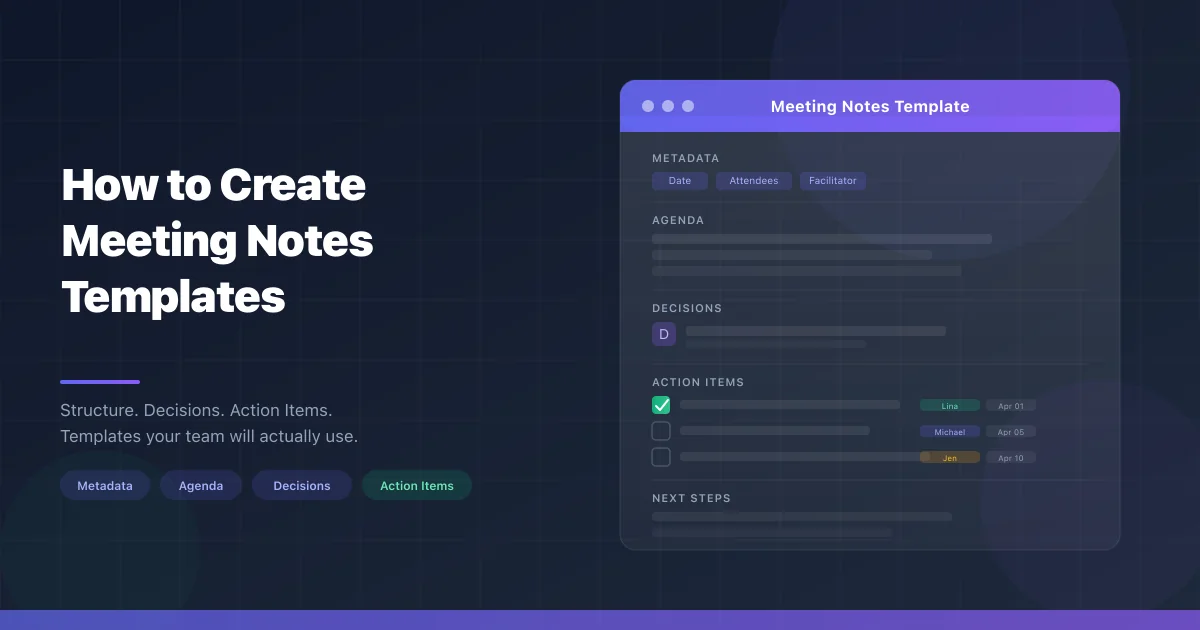 Using a structured template ensures every board meeting produces a complete, legally sound record.
The templates below are complete and ready to use. Copy and adapt them to your organization's needs.
Template 1: Corporate (For-Profit) Board of Directors Minutes
Use for: Annual board meetings, quarterly reviews, special sessions, major corporate decisions
MINUTES OF THE BOARD OF DIRECTORS MEETING
[COMPANY NAME]

Meeting Date: ___________________________
Meeting Time: _______________ to _______________
Location: ___________________________
Type of Meeting: [ ] Regular  [ ] Special  [ ] Annual

DIRECTORS PRESENT

1. _______________________________  [ ] In person  [ ] Remote
2. _______________________________  [ ] In person  [ ] Remote
3. _______________________________  [ ] In person  [ ] Remote
4. _______________________________  [ ] In person  [ ] Remote
5. _______________________________  [ ] In person  [ ] Remote

DIRECTORS ABSENT

1. _______________________________: Excused [ ] / Unexcused [ ]
2. _______________________________: Excused [ ] / Unexcused [ ]

OTHERS PRESENT (Officers, Counsel, Guests)

Name: _______________________________  Title: _______________
Name: _______________________________  Title: _______________

Quorum confirmed: [ ] Yes  [ ] No

I. CALL TO ORDER

The meeting was called to order at ___________ by Board Chair
_______________________________,
who confirmed that a quorum of directors was present and the meeting
was duly convened.

II. APPROVAL OF PREVIOUS MEETING MINUTES

The minutes of the [previous meeting date] board meeting were presented
for review.

MOTION: To approve the minutes of [previous meeting date] as presented
/ as amended.
Made by: ___________________________  Seconded by: ___________________________
Vote: In favor ___ | Opposed ___ | Abstained ___
Result: [ ] PASSED  [ ] FAILED  [ ] TABLED

III. AGENDA ITEM 1: ___________________________

Summary of discussion:
___________________________________________________________________

MOTION (if applicable): ___________________________________________________
Made by: ___________________________  Seconded by: ___________________________
Vote: In favor ___ | Opposed ___ | Abstained ___
Result: [ ] PASSED  [ ] FAILED  [ ] TABLED  [ ] NO VOTE REQUIRED

IV. AGENDA ITEM 2: ___________________________

Summary of discussion:
___________________________________________________________________

MOTION (if applicable): ___________________________________________________
Made by: ___________________________  Seconded by: ___________________________
Vote: In favor ___ | Opposed ___ | Abstained ___
Result: [ ] PASSED  [ ] FAILED  [ ] TABLED  [ ] NO VOTE REQUIRED

V. FINANCIAL REPORT

Period covered: ___________________________
Presented by: ___________________________

Key items noted:
___________________________________________________________________

MOTION (if applicable): ___________________________________________________
Made by: ___________________________  Seconded by: ___________________________
Vote: In favor ___ | Opposed ___ | Abstained ___
Result: [ ] PASSED  [ ] FAILED  [ ] TABLED

VI. ACTION ITEMS

| # | Action Item                  | Responsible Party     | Due Date   |
|---|------------------------------|-----------------------|------------|
| 1 |                              |                       |            |
| 2 |                              |                       |            |
| 3 |                              |                       |            |
| 4 |                              |                       |            |

VII. ADJOURNMENT

There being no further business, a motion to adjourn was made by
___________________________ and seconded by ___________________________.
The meeting was adjourned at ___________.

Respectfully submitted,

___________________________          Date: _______________
[Name], Corporate Secretary

Approved by:

___________________________          Date: _______________
[Name], Board Chair
Template 2: Nonprofit / Charity Board Meeting Minutes
Use for: Nonprofit boards, 501(c)(3) organizations, charities, foundations requiring IRS-compliant records
MINUTES OF THE BOARD OF DIRECTORS MEETING
[ORGANIZATION NAME], A [State] Nonprofit Corporation

EIN: ___________________________
Meeting Date: ___________________________
Meeting Time: _______________ to _______________
Location: ___________________________
Type of Meeting: [ ] Regular  [ ] Special  [ ] Annual  [ ] Emergency

BOARD MEMBERS PRESENT

1. _______________________________  [ ] Voting member  [ ] Ex officio
2. _______________________________  [ ] Voting member  [ ] Ex officio
3. _______________________________  [ ] Voting member  [ ] Ex officio
4. _______________________________  [ ] Voting member  [ ] Ex officio
5. _______________________________  [ ] Voting member  [ ] Ex officio

BOARD MEMBERS ABSENT

1. _______________________________: Excused [ ] / Unexcused [ ]
2. _______________________________: Excused [ ] / Unexcused [ ]

STAFF AND GUESTS PRESENT

Name: _______________________________  Role: _______________
Name: _______________________________  Role: _______________

Quorum confirmed: [ ] Yes: ___ of ___ voting members present

I. CALL TO ORDER

The meeting was called to order at ___________ by Board Chair
_______________________________,
who confirmed that a quorum was present and the meeting was properly
noticed.

II. CONFLICT OF INTEREST CHECK

The Chair asked whether any board member has a conflict of interest
regarding any agenda item.

Disclosures:
[ ] None disclosed.
[ ] Disclosed: _______________________________________________________________
   Action taken: ______________________________________________________________

III. APPROVAL OF PREVIOUS MEETING MINUTES

The minutes of the [previous meeting date] board meeting were presented.

Corrections noted: _______________________________________________________________

MOTION: To approve the minutes of [previous meeting date] as presented
/ as corrected.
Made by: ___________________________  Seconded by: ___________________________
Vote: In favor ___ | Opposed ___ | Abstained ___
Result: [ ] PASSED  [ ] FAILED

IV. EXECUTIVE DIRECTOR'S REPORT

Presented by: ___________________________

Summary of key updates:
___________________________________________________________________

Questions / board direction:
___________________________________________________________________

V. FINANCIAL REPORT

Period covered: ___________________________
Presented by: ___________________________

Financial highlights:
___________________________________________________________________

MOTION: To accept the financial report as presented.
Made by: ___________________________  Seconded by: ___________________________
Vote: In favor ___ | Opposed ___ | Abstained ___
Result: [ ] PASSED  [ ] FAILED

VI. AGENDA ITEM: ___________________________

Background / context:
___________________________________________________________________

Summary of discussion:
___________________________________________________________________

MOTION: ___________________________________________________________________
Made by: ___________________________  Seconded by: ___________________________
Vote: In favor ___ | Opposed ___ | Abstained ___
Result: [ ] PASSED  [ ] FAILED  [ ] TABLED

VII. COMMITTEE REPORTS

Committee: ___________________________  Chairperson: ___________________________
Summary: ___________________________________________________________________
Action / recommendation: _______________________________________________________

Committee: ___________________________  Chairperson: ___________________________
Summary: ___________________________________________________________________
Action / recommendation: _______________________________________________________

VIII. ACTION ITEMS

| # | Action Item                  | Responsible Party     | Due Date   |
|---|------------------------------|-----------------------|------------|
| 1 |                              |                       |            |
| 2 |                              |                       |            |
| 3 |                              |                       |            |

IX. NEXT MEETING

Date: ___________________________  Time: _______________
Location: ___________________________

X. ADJOURNMENT

MOTION: To adjourn the meeting.
Made by: ___________________________  Seconded by: ___________________________
The meeting was adjourned at ___________.

Respectfully submitted,

___________________________          Date: _______________
[Name], Board Secretary

Approved by the Board: _______________  (Date of approval at next meeting)
Template 3: Small Business Board / Advisory Board Minutes
Use for: Startup boards, advisory boards, small business investor meetings, founder-led boards
MEETING MINUTES
[COMPANY NAME], Board of Directors / Advisory Board

Meeting Date: ___________________________
Meeting Time: _______________ to _______________
Location / Platform: ___________________________

ATTENDEES

Board / Advisory Members:
- _______________________________ [ ] Present  [ ] Absent
- _______________________________ [ ] Present  [ ] Absent
- _______________________________ [ ] Present  [ ] Absent
- _______________________________ [ ] Present  [ ] Absent

Company Representatives:
- _______________________________ Title: _______________
- _______________________________ Title: _______________

Quorum: [ ] Met  [ ] Not met (number present: ___ / required: ___)

1. CALL TO ORDER

Meeting called to order at ___________ by _______________________________

2. APPROVAL OF PREVIOUS MINUTES

Previous meeting date: ___________________________

MOTION: To approve minutes as presented / as amended.
Made by: ___________________________  Seconded: ___________________________
Result: [ ] Approved  [ ] Rejected  [ ] Deferred

3. BUSINESS UPDATES

CEO / Founder Update:
___________________________________________________________________

Financial Highlights (period: _______________):
- Revenue: _______________
- Burn rate / expenses: _______________
- Cash runway: _______________
- Key metrics: _______________________________________________________________

4. AGENDA ITEM: ___________________________

Discussion summary:
___________________________________________________________________

Decision / Resolution:
___________________________________________________________________

MOTION (if formal vote required): ___________________________________________________
Made by: ___________________________  Seconded: ___________________________
Vote: For ___ | Against ___ | Abstain ___
Result: [ ] Passed  [ ] Failed  [ ] Tabled

5. AGENDA ITEM: ___________________________

Discussion summary:
___________________________________________________________________

Decision / Resolution:
___________________________________________________________________

MOTION (if formal vote required): ___________________________________________________
Made by: ___________________________  Seconded: ___________________________
Vote: For ___ | Against ___ | Abstain ___
Result: [ ] Passed  [ ] Failed  [ ] Tabled

6. ACTION ITEMS

| Owner                    | Action Item                         | Deadline   |
|--------------------------|-------------------------------------|------------|
|                          |                                     |            |
|                          |                                     |            |
|                          |                                     |            |

7. NEXT MEETING

Scheduled: ___________________________

8. ADJOURNMENT

Meeting adjourned at ___________ by _______________________________

Minutes prepared by: ___________________________  Date: _______________
Template 4: HOA (Homeowners Association) Board Meeting Minutes
Use for: HOA boards, condo associations, planned communities, residential governance
MINUTES OF THE BOARD OF DIRECTORS MEETING
[HOA NAME] HOMEOWNERS ASSOCIATION

Meeting Date: ___________________________
Meeting Time: _______________ to _______________
Location: ___________________________
Type of Meeting: [ ] Regular  [ ] Special  [ ] Annual

BOARD MEMBERS PRESENT

President: ___________________________
Vice President: ___________________________
Secretary: ___________________________
Treasurer: ___________________________
Member at Large: ___________________________

BOARD MEMBERS ABSENT: ___________________________

HOMEOWNERS / RESIDENTS IN ATTENDANCE: ___ residents present
(Sign-in sheet attached: [ ] Yes  [ ] No)

Property Manager (if applicable): ___________________________

Quorum confirmed: [ ] Yes  [ ] No

I. CALL TO ORDER

The meeting was called to order at ___________ by President
_______________________________,
who confirmed that a quorum was present.

II. APPROVAL OF PREVIOUS MEETING MINUTES

MOTION: To approve the minutes of [previous meeting date].
Made by: ___________________________  Seconded by: ___________________________
Result: [ ] APPROVED  [ ] APPROVED AS AMENDED  [ ] DEFERRED

III. HOMEOWNER OPEN FORUM

(Maximum ___ minutes per homeowner. Board to respond where possible;
other items noted for follow-up.)

Issue raised: ___________________________________________________________________
  Action / response: ___________________________________________________________________

Issue raised: ___________________________________________________________________
  Action / response: ___________________________________________________________________

IV. TREASURER'S REPORT

Period: ___________________________
Balance in operating account: $ _______________
Balance in reserve fund: $ _______________
Outstanding assessments (delinquent): $ _______________

Key items:
___________________________________________________________________

MOTION: To accept the Treasurer's report.
Made by: ___________________________  Seconded by: ___________________________
Result: [ ] APPROVED  [ ] DEFERRED

V. COMMITTEE REPORTS

Landscaping / Grounds: ___________________________________________________________________
Architectural Review Committee: ___________________________________________________________________
Rules & Compliance: ___________________________________________________________________
Other: ___________________________________________________________________

VI. OLD BUSINESS

Item: ___________________________
Status / update: ___________________________________________________________________
MOTION (if applicable): ___________________________________________________________________
Made by: ___________________________  Seconded by: ___________________________
Result: [ ] PASSED  [ ] FAILED  [ ] TABLED

VII. NEW BUSINESS

Item: ___________________________
Discussion: ___________________________________________________________________
MOTION (if applicable): ___________________________________________________________________
Made by: ___________________________  Seconded by: ___________________________
Result: [ ] PASSED  [ ] FAILED  [ ] TABLED

Item: ___________________________
Discussion: ___________________________________________________________________
MOTION (if applicable): ___________________________________________________________________
Made by: ___________________________  Seconded by: ___________________________
Result: [ ] PASSED  [ ] FAILED  [ ] TABLED

VIII. ACTION ITEMS

| # | Action Item                          | Responsible      | Due Date   |
|---|--------------------------------------|------------------|------------|
| 1 |                                      |                  |            |
| 2 |                                      |                  |            |
| 3 |                                      |                  |            |

IX. NEXT MEETING

Date: ___________________________  Time: _______________
Location: ___________________________

X. ADJOURNMENT

MOTION: To adjourn.
Made by: ___________________________  Seconded by: ___________________________
Meeting adjourned at ___________.

Respectfully submitted,

___________________________          Date: _______________
[Name], HOA Secretary

Approved: _______________  (Date approved at next board meeting)
Which Template Should You Use?
START: What type of board are you documenting?
|
+-- FOR-PROFIT CORPORATION
|   |
|   +-- Has investors, formal directors, Delaware/state incorporation?
|       |
|       +-- YES -> Template 1: Corporate Board Minutes
|              Includes motions, vote counts, fiduciary language
|
+-- NONPROFIT / CHARITY
|   |
|   +-- 501(c)(3), state nonprofit, or charity?
|       |
|       +-- YES -> Template 2: Nonprofit Board Minutes
|              Includes conflict of interest check, IRS-friendly format
|
+-- SMALL BUSINESS / STARTUP
|   |
|   +-- Founder board, advisory board, investor board?
|       |
|       +-- YES -> Template 3: Small Business Advisory Board
|              Lean format with CEO updates and financial highlights
|
+-- HOMEOWNERS ASSOCIATION
    |
    +-- HOA, condo association, residential community?
        |
        +-- YES -> Template 4: HOA Board Minutes
               Includes homeowner forum, reserve fund, ARC reports
| Organization Type | Template | Key Sections |
|---|---|---|
| For-profit corporation | #1 Corporate | Motions, vote counts, corporate secretary |
| Nonprofit / 501(c)(3) | #2 Nonprofit | Conflict of interest, EIN, IRS-compliant format |
| Startup / advisory board | #3 Small Business | CEO update, financials, lean format |
| HOA / condo association | #4 HOA | Homeowner forum, treasurer report, ARC |
How to Write Board Meeting Minutes: Step-by-Step
 Effective minutes require preparation before, focused capture during, and prompt drafting after the meeting.
Having a template is the foundation. Using it well requires understanding the process from start to finish.
Before the Meeting
1. Obtain the agenda in advance. Review the agenda before the meeting so you know what topics will be covered, which items require a formal vote, and where you should pay particular attention.
2. Gather reference documents. Pull the prior meeting's minutes, relevant committee reports, and any resolutions that may be referenced during discussion.
3. Prepare your recording setup. Whether you take notes by hand, on a laptop, or use an audio transcription tool, have your system ready before the meeting begins.
During the Meeting
4. Record the basics immediately. As soon as the meeting starts, note the exact time, confirm who is present, and verify that quorum is met. These facts cannot be reconstructed accurately after the fact.
5. Capture motions verbatim. When a motion is made, write down the exact words. Do not paraphrase. Record who made the motion, who seconded it, the vote count, and the result.
6. Summarize discussion; do not transcribe it. Your job is to capture the substance and outcome of discussions, not every word spoken. A good summary captures the key arguments made and any significant concerns raised, especially if they informed a vote.
7. Note conflicts of interest and abstentions. If a director discloses a conflict and recuses from a vote, record it explicitly. The same applies to abstentions: note them and, if the director gave a reason, record that too.
8. Capture action items in real time. Do not wait until after the meeting to reconstruct action items. Record the task, the responsible party, and the deadline as they are assigned.
After the Meeting
9. Draft the minutes promptly. The sooner you draft after the meeting, the more accurate your summary will be. Aim to have a draft ready within 24 to 48 hours.
10. Use precise, neutral language. Write in past tense. Use formal language. Avoid adjectives that characterize the quality of a discussion. Stick to facts.
11. Circulate for review. Share the draft with the board chair and, where appropriate, other directors for factual corrections before the next meeting. Minutes are approved at the following meeting, not by email correction in most governance frameworks.
12. Maintain the official record. Once approved, file the final minutes in a secure, permanent location, physically and digitally. Apply your organization's retention policy.
📊 Fact Box: Minutes Drafting Time Benchmarks
- Manual drafting from handwritten notes: 2 to 4 hours average
- Manual drafting from a recording: 1 to 2 hours average
- AI-assisted drafting (transcription plus summary): 15 to 30 minutes
- Distribution within 24 hours: 87% action item completion rate
- Distribution after 48 hours: drops to 31% completion rate
Sources: Meeting Effectiveness Study 2025, Project Management Institute
Common Mistakes to Avoid
Even experienced secretaries make these errors. Check your minutes against this list before filing.
Recording opinions instead of outcomes. Minutes should reflect what was decided, not what people said they thought. "The board discussed marketing strategies" is appropriate. "Several directors felt the current marketing was inadequate" introduces subjectivity.
Incomplete motion language. Every motion needs: who made it, who seconded it, what was voted on (in clear terms), and the result. A motion without a vote count or outcome is incomplete.
Missing quorum confirmation. If quorum was not established, any votes taken may be legally invalid. Always confirm and record quorum at the top of the minutes.
Failing to record abstentions. An abstention is a meaningful governance act. It must be recorded.
Conflating approved and draft minutes. The minutes being taken at a meeting are always a draft until approved at the subsequent meeting. Do not mark them as final or "approved" until that approval occurs.
Excessive detail. Verbatim transcripts are not minutes. They create legal risks by capturing off-hand remarks, speculative statements, or privileged discussions that belong outside the official record.
Inconsistent formatting over time. Use the same template and format consistently. Minutes that change style significantly from meeting to meeting are harder to use as a legal record and raise questions about completeness.
📊 Fact Box: Most Common Minutes Errors (Survey of Corporate Secretaries)
- 62% report inconsistent motion documentation across meetings
- 48% say quorum confirmation is sometimes missing from older records
- 41% have encountered minutes that include verbatim debate transcripts
- 35% note abstentions are regularly omitted
- 29% say drafts circulate without being clearly labeled as drafts
Sources: Society of Corporate Secretaries Survey, 2025
How AI Speeds Up Board Minutes Drafting
 AI tools like KenzNote handle transcription and summarization, letting the secretary focus on accuracy and judgment.
The hardest part of writing board minutes is not the formatting. It is producing an accurate, well-organized written record shortly after a meeting that may have covered hours of complex discussion.
AI tools are transforming this process at every stage.
From Recording to Draft in One Workflow
Modern AI meeting tools can handle the full pipeline.
1. Audio capture. Record the board meeting on your device. No integrations, calendar access, or IT permissions required for tools like KenzNote.
2. Automatic transcription. The recording is transcribed with speaker identification, producing a full text record of the meeting within minutes.
3. AI summarization. The AI analyzes the transcript and generates a structured summary: key decisions, motions discussed, action items, and who said what, all organized by agenda item.
4. Minutes drafting. Using the AI-generated summary alongside your template, you can produce a complete draft in a fraction of the time it takes to draft from handwritten notes alone.
What AI Does Well
- Capturing motion language accurately when the recording is clear
- Identifying action items from conversational discussion
- Organizing outputs by agenda section
- Flagging decisions and vote outcomes
- Providing a searchable transcript for later reference
What Still Requires Human Judgment
- Determining which discussion points belong in the official record
- Applying legal privilege to sensitive matters
- Confirming quorum and attendance accuracy
- Final review for accuracy before approval
AI handles the labor. The secretary handles the judgment.
📊 Fact Box: AI Meeting Tool Adoption for Board Minutes
- 78% of Fortune 500 companies now use AI meeting tools for some meetings
- Time savings: 30 to 60 minutes reduced to 5 to 15 minutes per meeting
- Transcription accuracy: 95 to 98% vs 40 to 60% for manual notes
- ROI breakeven: typically within 2 to 3 weeks of adoption
- Adoption growth: 127% year-over-year increase (2024 to 2026)
Sources: Gartner AI Workplace Report, G2 Meeting Software Reviews
KenzNote Workflow for Board Meeting Minutes
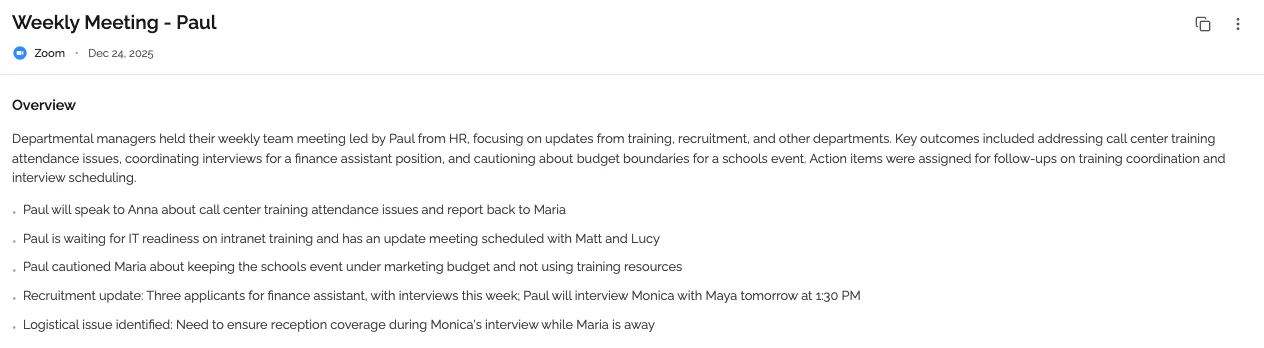 KenzNote processes your board meeting recording and delivers a structured summary in minutes.
KenzNote is an AI meeting notes app built for exactly this use case: capturing and summarizing meetings without requiring calendar access or software integrations.
Step 1: Record. Open KenzNote on your phone or laptop before the board meeting starts. Tap record. There is no setup, no calendar sync, and no need for IT involvement. The app works anywhere: in-person meetings, hybrid calls, or remote video sessions.
Step 2: Transcribe. After the meeting ends, KenzNote processes the recording and produces a full transcript with speaker identification. This gives you an accurate, searchable record of everything discussed.
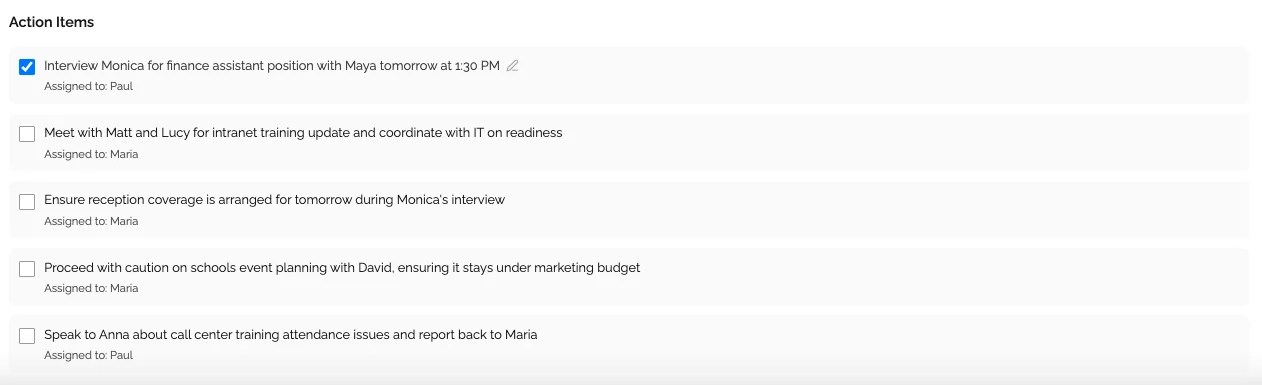 Action items are automatically extracted with owners and deadlines identified from natural conversation.
Step 3: Draft minutes. KenzNote generates a structured summary of decisions, motions, action items, and key discussion points. Take that output, apply it to your board minutes template, and your draft is ready for review, in minutes rather than hours.
Pricing: KenzNote operates on a pay-per-use model at $0.99 per meeting. There is no subscription, no monthly fee, and no minimum commitment. You pay only for the meetings you record.
For boards that meet quarterly, this means the annual cost for AI-assisted minutes is under $5.
| Method | Drafting Time | Accuracy | Cost |
|---|---|---|---|
| Handwritten notes only | 2 to 4 hours | 40 to 60% capture | $0 |
| Audio recording + manual review | 1 to 2 hours | 95%+ | $0 |
| AI-assisted (KenzNote) | 15 to 30 minutes | 95 to 98% | $0.99/meeting |
| Professional transcription service | Next day | 98%+ | $60 to $150/hour |
Frequently Asked Questions
Are board meeting minutes legally required?
Yes, in most jurisdictions. Corporations are generally required by state law to maintain minutes of board meetings. Nonprofit organizations typically face similar requirements under state nonprofit corporation acts, and IRS compliance expectations reinforce this obligation. The specific requirements vary by state and entity type. Consult legal counsel to understand the requirements applicable to your organization.
How long do you need to keep board meeting minutes?
Retention requirements vary. Many governance best practices and state laws recommend keeping board minutes permanently; they are considered a core corporate record. At minimum, most organizations retain minutes for seven to ten years. The IRS can generally audit nonprofit organizations within three years of filing (or six years in cases of substantial underreporting), so minutes supporting decisions made during those periods should be readily accessible. Your legal counsel or accountant can advise on the specific retention schedule appropriate for your organization type and jurisdiction.
Who is responsible for taking board meeting minutes?
The corporate secretary (or board secretary for nonprofits) is typically responsible for recording and maintaining board minutes. In small organizations or boards without a designated secretary, this role may be assigned to a staff member, an executive director, or rotated among directors. The board chair is responsible for ensuring the function is fulfilled.
Do board minutes need to be approved?
Yes. Board minutes are typically reviewed and formally approved at the next board meeting. Directors may propose corrections to factual errors before approval. Once approved, the minutes become the official record of the meeting. In some organizations, electronic approval between meetings is permitted under the bylaws.
Can board meeting minutes be taken verbatim?
They can be, but doing so is generally not recommended. Verbatim transcripts capture off-hand remarks, speculation, and privileged attorney-client communications that are inappropriate for the official record. Minutes should summarize the substance of discussions and record decisions and votes precisely. The goal is an accurate, professionally composed summary, not a word-for-word account.
Can AI-generated transcripts be used as official board minutes?
A raw AI transcript is not appropriate as official board minutes. It contains everything said, including off-the-record comments and privileged discussions, without the organizational structure and editorial judgment that proper minutes require. However, an AI transcript is an excellent source document for drafting minutes. The secretary reviews the transcript, selects the relevant content, applies it to a formal template, and produces the official record. The transcript itself may be retained separately as a working document.
What is the difference between board minutes and board resolutions?
Minutes are the comprehensive record of a board meeting: attendance, discussion, and all actions taken. A resolution is a formal written document expressing a specific decision or policy of the board. Resolutions are often recorded within the minutes when a formal vote is taken, but organizations sometimes also prepare standalone written resolutions for significant decisions like major contracts, officer appointments, or banking authorizations.
Can board minutes be amended after approval?
Yes, but with care. If an error is discovered after minutes have been approved, the correction should be made at a subsequent board meeting with a formal motion to amend, and the amendment itself should be recorded in those later minutes. The original approved minutes should not be silently altered. This preserves the integrity of the historical record.
What happens if a board does not keep meeting minutes?
Failing to maintain adequate minutes can result in fines, loss of legal protections (including piercing the corporate veil for shareholder liability), loss of nonprofit tax-exempt status, problems during audits or regulatory investigations, and difficulties in litigation. Minutes are one of the primary ways courts and regulators assess whether an organization followed proper governance procedures.
How quickly should board meeting minutes be drafted?
Best practice is to draft within 24 to 48 hours while the context is still fresh. AI tools like KenzNote can help produce a structured summary within minutes of the meeting ending, making same-day drafts achievable. The draft circulates to the board chair for review before being formally approved at the next meeting.
Summary
Board meeting minutes are one of the most important governance documents your organization produces. When done correctly, they protect the board, satisfy legal obligations, and create an authoritative record that serves your organization for years.
Use the templates in this guide as your starting point. Apply them consistently. Review your minutes before filing. And if you are looking to reduce the time between meeting and finished draft, a tool like KenzNote can handle the transcription and summarization, letting you focus on accuracy and judgment rather than note-taking.
Related Resources
- Meeting Minutes Templates: 10 Free Templates for Every Meeting Type
- How to Create a Meeting Notes Template
- How to Organize Meeting Notes
- Best AI Meeting Note Taker Apps 2026
- Automatic Meeting Notes: Complete Guide
- Is It Legal to Record Meetings? State-by-State Guide
- AI Meeting Notes: Complete Guide 2026
Ready to spend less time drafting and more time governing?
Try KenzNote Free and let AI handle transcription and summarization. Your board minutes draft will be ready before the next board member checks their email.
Questions? Email [email protected]
These templates are provided for informational purposes and do not constitute legal advice. Requirements for board meeting minutes vary by jurisdiction and organization type. Consult a qualified attorney to ensure your minutes format and retention practices comply with applicable law.
References & Citations
- [1]Robert's Rules of Order: Meeting Minutes RequirementsFor Dummies. January 1, 2024https://www.dummies.com/article/business-careers-money/business/general-business/meeting-minutes-according-to-roberts-rules-171788/
All external sources have been reviewed for accuracy and relevance. Last verified: September 2026.

About Muhammad Abuelenin
Muhammad is the co-founder of KenzNote, passionate about building tools that enhance productivity and collaboration. With expertise in full-stack development and AI-powered solutions, he's dedicated to helping teams work smarter through innovative technology.
Ready to transform your meetings?
KenzNote automatically captures meeting insights, extracts action items, and generates summaries so you can focus on the conversation instead of taking notes.
Try KenzNote Free