
Quick Answer: Yes, in many cases. When a bot named "Fireflies.ai" or "Otter.ai" joins your client call, it signals that the conversation is being recorded and analyzed by a third-party tool. Some clients find this entirely normal. Others find it unsettling, especially in early-stage relationships, sensitive negotiations, or industries with strong privacy expectations. Knowing when a bot hurts you and when it does not is a practical skill for anyone who uses AI meeting tools professionally.
Key Takeaways
- AI meeting bots are visible third parties. When they join a call, every participant can see them.
- Client discomfort with recording bots is real and varies by industry, relationship stage, and individual preference.
- In high-trust, established client relationships, a bot is usually not an issue if disclosed in advance.
- In early sales calls, sensitive negotiations, or regulated industries, a bot can cost you the deal before you start.
- Botless recording tools eliminate the social friction while preserving all the AI benefits.
- Consent and transparency are legal requirements in many jurisdictions, not just professional courtesies.
Table of Contents
- The Bot Joins the Meeting
- Why Some Clients Care
- When a Bot Is Fine
- When a Bot Creates Problems
- The Legal Layer: Consent and Compliance
- How to Handle It Professionally
- Botless Recording as an Alternative
- FAQ
- Related Resources
The Bot Joins the Meeting
You schedule a call with a new prospect. They open the meeting link. Before you even start talking, a notification appears: "Fireflies has joined the meeting." Or "Otter.ai Notetaker has joined." Or "KenzBot is recording this meeting."
The prospect reads it. They may say nothing. They may ask about it. They may quietly become more guarded. They almost certainly register it.
This is the bot problem. AI meeting bots are not invisible. They show up as participants in the meeting, listed in the attendee panel, sometimes with their own video tile or camera icon. They are, by design, transparent about their presence. The question is whether that transparency helps or hurts you in any given situation.
For internal meetings between colleagues, the answer is almost always: it does not matter much. Everyone knows the culture, trusts each other, and understands that notes are being taken. But client-facing calls are different. The client does not work for you. They are evaluating you. And what they see in the first few seconds of a call shapes their impression of how you operate.
Harvard Business Review research on first impressions notes that people form initial assessments in seconds and update them slowly. An unexpected bot joining a first call is not a neutral event.
 Recording without a bot removes the visible third-party presence from your client calls.
Why Some Clients Care
Not every client will react negatively to a meeting bot. But the ones who do will react for predictable reasons.
Privacy instinct. Many professionals have a visceral discomfort with being recorded, even when they know recording is legal and common. This is not irrational. People speak differently when they know they are on the record. The presence of a named AI tool from a company they have never heard of intensifies this discomfort.
Data ownership uncertainty. A sophisticated client may wonder: who owns this transcript? Where is it stored? Is this tool trained on conversations? Is my proprietary information going into a third-party system? These are reasonable questions, and most people do not ask them aloud. They just become more careful about what they say.
Professional context mismatch. In some industries, the presence of a third-party recording tool signals a lack of professionalism or a surveillance mindset. A doctor, lawyer, therapist, or financial advisor on a client call expects a certain level of discretion. An AI bot from a startup joining their call without prior discussion can feel jarring.
Relationship stage friction. In a mature client relationship, recording calls is understood and accepted. In the first or second call with a new prospect, anything unexpected creates cognitive friction. The prospect is already assessing you. A bot they did not know would be there becomes part of that assessment.
Gallup research on workplace trust consistently shows that trust is foundational to professional relationships and erodes quickly under conditions of perceived surveillance or lack of transparency.
When a Bot Is Fine
There are many situations where a meeting bot is entirely appropriate and causes no friction at all.
Established client relationships. When you have worked with a client for months or years, they know how you operate. If you have mentioned that you use an AI notetaker, or if it has come up naturally in past calls, a bot joining is unremarkable.
Internal team meetings. Standups, sprint planning, retrospectives, all-hands meetings, and any internal session benefit enormously from AI notes without any of the relationship dynamics that make bots complicated in client calls.
Sales calls with prior disclosure. If you include a note in the calendar invite that the meeting will be recorded for internal notes, most prospects accept this as standard practice. The disclosure removes the surprise factor.
Technical or training sessions. When you are running a product demo, onboarding session, or technical walkthrough, recording is almost expected. Clients often want the recording themselves for reference. A bot joining is natural in this context.
High-volume pipeline calls. Sales development reps who run 8 to 10 discovery calls per day need systematic note-taking. In this context, the bot is part of a professional workflow, and most prospects in a B2B context are familiar with it.
The key variable in all of these cases is the combination of prior disclosure and relationship context. When clients know to expect recording and have reason to trust you, bots are fine.
When a Bot Creates Problems
There are specific situations where a bot joining your call is a liability, not an asset.
First sales calls with enterprise prospects. Large enterprise buyers are often security-conscious. Their legal or IT teams may have policies about third-party recording tools. A bot joining without prior notice can trigger a compliance concern that derails the conversation before you have made your pitch.
Sensitive negotiations. Pricing discussions, contract negotiations, and difficult conversations about scope changes or service failures benefit from a candid, off-the-record tone. A bot changes the dynamic. People become more formal, more careful, and less likely to say what they actually think.
Regulated industries. Legal, healthcare, financial services, and government sectors have explicit rules about data handling and recording consent. A bot joining without formal consent documentation is a compliance risk, not just a social one. See our detailed article on meeting recording legality for jurisdiction-specific guidance.
Executive-level conversations. C-suite executives often expect a certain level of discretion. A bot joining their call suggests that the conversation is being processed by a third party. Some executives are entirely comfortable with this; others will not continue the meeting until they understand exactly what is happening with their words.
Therapy, coaching, or confidential advisory calls. Any professional whose work involves confidential conversations with clients has a specific obligation to handle recording with explicit consent and clear data governance. A standard AI bot from a meeting tool company does not meet that bar. See our guides on AI notetakers for therapists and lawyers for context.
 In sensitive or early-stage client conversations, the presence of a third-party recording bot can shift the dynamic before you say a word.
The Legal Layer: Consent and Compliance
Beyond professional courtesy, recording calls has legal dimensions that vary by jurisdiction.
In the United States, federal law requires one-party consent for recording: one person on the call (you) needs to know the recording is happening. But 11 states have two-party or all-party consent laws, meaning everyone on the call must consent. California, Illinois, and Florida are among them.
In the European Union, GDPR requires explicit, informed consent for data processing. Recording a call and sending the transcript to a third-party AI tool is data processing. You need consent, and you need to be able to document it.
In the United Kingdom, similar rules apply under the UK GDPR framework.
The practical implication: announcing that the meeting is being recorded, either verbally or via a calendar notice, is not just polite. In many jurisdictions, it is legally required. A bot joining the meeting serves as a visible notification, which is one reason they are designed to announce themselves. But visible notification and legally valid consent are not the same thing in every jurisdiction.
For a thorough breakdown of recording consent requirements, see our article on whether it is legal to record meetings.
How to Handle It Professionally
If you use a bot-based recorder for client calls, here are the practices that minimize friction.
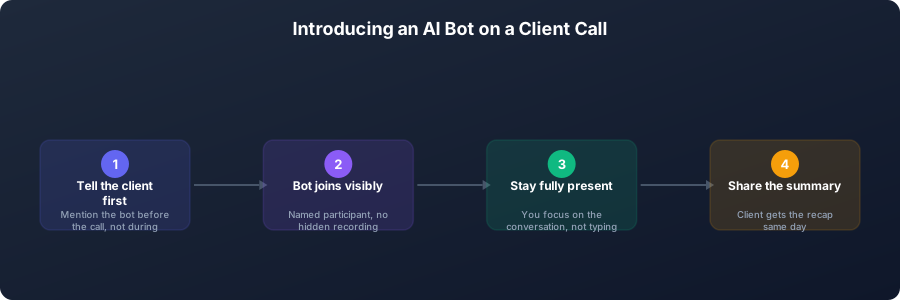 Telling the client before the call starts is the single biggest factor in how the bot is received.
Disclose in the calendar invite. Add a line to every meeting description: "This call may be recorded for internal notes. Let me know if you have any questions." Most people will never mention it. Those who do will appreciate the transparency.
Ask at the start of the call. A simple verbal check: "I use an AI notetaker to capture action items so I can follow up accurately. Is that okay with you?" In most cases, the answer is yes, and you have created a moment of transparency that builds trust rather than eroding it.
Know your client. For new prospects in regulated industries or senior enterprise stakeholders, consider whether you need the AI notes badly enough to risk the friction. If the answer is no, turn off the bot for that call and take notes manually or use a botless recorder.
Be ready to explain. If a client asks about the bot, be specific: what tool it is, where the transcript goes, who can access it, and what data protection commitments the tool makes. If you cannot answer those questions, you probably should not be using the tool in client calls.
Consider data governance. If you are using an AI meeting tool, know what it does with your data. Most subscription tools reserve rights to use data for model improvement. Some, like KenzNote, make a contractual commitment to never train on your meeting content. This distinction matters in client conversations. See our article on whether AI meeting assistants train on your data for a tool-by-tool comparison.
Botless Recording as an Alternative
Botless recording eliminates the visible third-party presence entirely. Instead of a named bot joining as a participant, your device records the audio directly. The transcript is generated from that recording. No bot appears in the attendee list. No notification announces that an external tool has joined.
The practical benefits for client calls:
- No unexpected participant joining the meeting
- No client questions about what tool is in the meeting or who operates it
- No compliance risk from a bot that technically "joins" the meeting as a participant
- Identical AI features (transcription, summaries, action items, chat) without the social friction
KenzNote records without a bot. The recorder runs locally on your device and captures the meeting audio without joining as a participant. Clients see only you and the other human participants on the call.
For sales teams, this is significant. Our article on AI notetakers for sales teams covers how botless recording affects pipeline conversations specifically.
For a deeper comparison of bot-based and botless recording approaches, see our bot-free AI meeting recorder guide for 2026.
 Botless recording delivers all the AI features without announcing itself to your clients.
FAQ
Do I have to tell clients I am recording?
In most jurisdictions, yes. US federal law requires one-party consent (you), but 11 states require all-party consent. The EU requires explicit consent under GDPR. Even where it is not legally required, disclosing recording is a professional standard that protects your relationships and your business.
Will clients refuse calls if they see a bot has joined?
Rarely, but it happens. More common is that clients become more guarded without saying anything. You may never know the bot cost you candor in the conversation. The risk is difficult to measure but real.
Can I turn off the bot for specific calls?
Yes. With most bot-based tools, you can disable the bot on a per-meeting basis. For recurring calls where you want AI notes, keep it on. For sensitive first calls or negotiations, turn it off. This is a reasonable middle approach if you prefer a subscription-based tool.
Is botless recording as accurate as bot recording?
Accuracy depends on microphone quality and the transcription engine, not on whether a bot joined. KenzNote's botless recording uses the same AI transcription engine as its standard mode. The absence of a bot does not affect transcript quality.
What should I say if a client asks why the bot is there?
Be direct: "That is my AI notetaker. It captures the transcript so I can follow up on action items accurately. It does not share data with anyone outside our company, and I can turn it off if you prefer." That answer is honest, specific, and gives the client a choice.
Does using a botless recorder mean I can record without consent?
No. The legal requirement for consent is about recording, not about how the recording is done. Botless recording still requires the same disclosures and consent as bot-based recording. The difference is social and professional, not legal.
Related Resources
References & Citations
- [1]State of the American WorkplaceGallup. January 1, 2023https://www.gallup.com/workplace/285818/state-american-workplace-report.aspx
- [2]How to Make a Great First ImpressionHarvard Business Review. April 1, 2016https://hbr.org/tip/2016/12/make-a-great-first-impression
- [3]Digital Trust and PrivacyMicrosoft WorkLab. January 1, 2024https://www.microsoft.com/en-us/worklab/work-trend-index
All external sources have been reviewed for accuracy and relevance. Last verified: October 2026.

About KenzNote Team
The KenzNote team is dedicated to helping teams capture better meeting insights and transform how they collaborate. With backgrounds in AI, product design, and enterprise software, we're building the future of meeting productivity.
Ready to transform your meetings?
KenzNote automatically captures meeting insights, extracts action items, and generates summaries so you can focus on the conversation instead of taking notes.
Try KenzNote Free