
Quick Answer
Conversation intelligence software records, transcribes, and analyzes your sales calls, then surfaces insights like how much your reps talk vs. listen, what objections come up most, and which deals are at risk. Enterprise tools like Gong cost $70,000+/year. For most SMB sales teams, you can get 80% of the value at 1% of the cost using tools like KenzNote at $0.99/meeting.
Key Takeaways
- Conversation intelligence goes beyond recording: AI analyzes talk-to-listen ratios, objections, competitor mentions, and sentiment to surface coaching data
- Top reps talk 40 to 46% of the time: Discovery calls where reps listen more generate better qualification data and higher close rates
- Enterprise tools are genuinely expensive: Gong runs $1,200 to $1,600 per user per year with minimum contracts above $70,000
- SMBs can start today for under $20/month: KenzNote at $0.99/meeting gives you transcripts, speaker labels, and AI summaries without a contract
- The biggest wins come from coaching: Managers stop guessing and start coaching with evidence from real calls
- Ramp time drops 30 to 50%: New reps learn from curated libraries of real calls instead of role-play exercises
Table of Contents
- What Is Conversation Intelligence?
- How It Works
- Key Metrics Tracked
- Benefits for Sales Teams
- Enterprise vs. SMB Tools
- Comparison Table
- How to Get Started Without an Enterprise Budget
- Use Cases
- Frequently Asked Questions
Conversation Intelligence for Sales: Complete Guide 2026
Your best reps close more deals, and it is not random. They ask better questions. They pause after pricing. They let prospects talk. They handle objections without going defensive. The problem is that most sales managers cannot tell you exactly what those reps do differently, because the only evidence lives inside calls they have never heard.
Conversation intelligence changes that. It turns every sales call into structured coaching data, so you stop relying on gut feel and start building a team that wins on purpose.
What Is Conversation Intelligence?
If you have never heard the term before, you are not alone. Conversation intelligence is a category of software that goes beyond simple call recording. It uses AI to analyze what actually happens in your sales conversations: not just what was said, but how it was said, who did most of the talking, which topics came up, and how prospects responded.
Think of it as a performance coach that sits in on every sales call and gives your team detailed feedback afterward, without anyone having to take manual notes or rely on memory.
The core idea is simple. Your best reps close more deals because of specific behaviors on calls. Conversation intelligence helps you identify those behaviors, replicate them across the team, and catch problems before they cost you a deal.
For sales managers, this means you stop guessing and start coaching with evidence. For reps, it means faster onboarding, better call preparation, and a clearer path to hitting quota.
How Conversation Intelligence Software Works
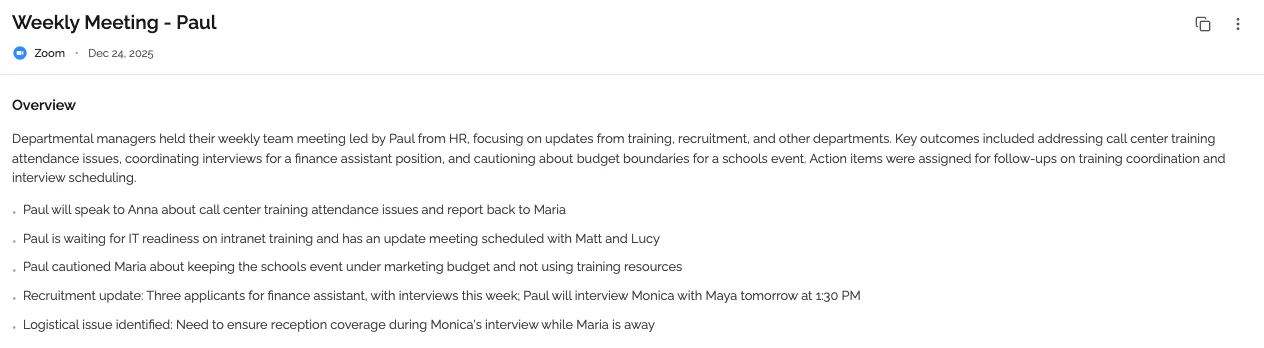 Conversation intelligence in practice: Every call becomes a structured record with speaker-labeled transcript and AI summary.
Modern conversation intelligence tools follow a similar process:
1. Recording and transcription
The tool joins your sales calls on Zoom, Google Meet, or Microsoft Teams and records the conversation. It then generates a full transcript, typically with speaker labels so you can see exactly who said what.
2. AI analysis
This is where conversation intelligence separates from plain transcription. The AI analyzes the transcript and audio for dozens of signals:
- Talk-to-listen ratio: What percentage of the call did your rep talk versus the prospect? Top performers typically talk 40 to 46% of the time and let prospects talk the rest.
- Monologue length: How long does the rep speak before pausing for a response? Long uninterrupted stretches often signal poor call control.
- Questions asked: How many questions did the rep ask? Discovery-heavy calls tend to outperform pitch-heavy calls.
- Objection detection: The AI flags moments where pricing, competition, or hesitation came up.
- Competitor mentions: Did the prospect name a competitor? When did they bring it up, and how did the rep respond?
- Sentiment analysis: Did the prospect's tone shift positively or negatively at certain moments?
- Filler words: Excessive use of "um," "uh," or "basically" can undermine credibility and confidence.
3. Summaries and action items
The tool generates a summary of what was discussed, key takeaways, and follow-up actions, saving reps 10 to 20 minutes of post-call admin work per meeting.
4. Coaching and reporting
Managers can review calls, leave timestamped comments, and pull team-wide reports to spot patterns. Which reps handle pricing objections best? Which deals show warning signs? Conversation intelligence answers these questions with data rather than gut feel.
Key Metrics Conversation Intelligence Tracks
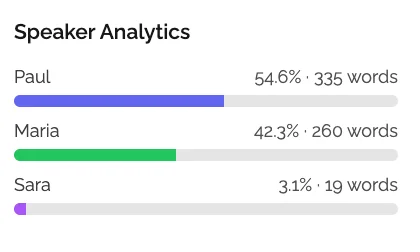 Speaker analysis: See exactly who talked how much on every call, surfacing coaching opportunities at a glance.
Here are the specific data points that make conversation analytics valuable for sales teams:
Talk-to-listen ratio The most cited metric in sales coaching. Research from Gong's own data suggests top closers let prospects talk more than they do. A rep talking 70%+ of the time on a discovery call is a red flag.
Questions asked per call More questions generally correlate with better discovery. Tracking this over time shows whether reps are improving their consultative approach.
Longest monologue If a rep speaks for four or more minutes without stopping, prospects disengage. Monitoring this helps managers coach for better two-way conversations.
Filler word count High filler word usage, particularly on pricing conversations, can signal nervousness and reduce buyer confidence.
Response time to objections How quickly does the rep respond to a pricing objection? Immediate deflection versus a pause and thoughtful response often produce different outcomes.
Competitor mentions When prospects mention competitors, how reps handle that moment is critical. Conversation intelligence flags these moments for review.
Call-to-meeting ratio correlation Over time, you can correlate call quality scores with deal outcomes to understand which behaviors actually move the needle on revenue.
Benefits for Sales Teams
Conversation intelligence is not just about monitoring. It is a genuine force multiplier across the entire revenue operation.
Faster onboarding
New reps can listen to top performers' calls filtered by scenario: discovery calls, pricing conversations, objection handling. Learning from real examples beats role-playing exercises every time. Companies using conversation intelligence typically cut ramp time by 30 to 50%.
Consistent coaching
Managers can only listen to so many calls manually. Conversation intelligence gives them data-driven prioritization: coach on the calls that actually need it, not just whoever happens to be in front of them.
Deal risk visibility
When a deal has gone quiet, conversation intelligence can surface why. Did the last call have too many unresolved objections? Did a competitor come up and never get addressed? This context helps managers intervene before a deal is lost.
Scalable playbook enforcement
Once you know which behaviors drive wins, you can turn them into a codified playbook and measure whether reps are following it, without listening to every call yourself.
Better customer understanding
Aggregated conversation data reveals what prospects actually care about, what language resonates, and what objections come up repeatedly. This feeds directly into marketing messaging, product roadmaps, and sales collateral.
Key stat: Sales teams using conversation intelligence report 15 to 20% win rate increases and 70% reduction in post-call admin time. For a 10-person team, that adds up to hundreds of hours recovered per year.
Enterprise vs. SMB Conversation Intelligence Tools
Here is where most SMB sales leaders get stuck. They research conversation intelligence, find Gong or Chorus, and immediately move on because the price is out of reach. That is understandable, but there are now legitimate alternatives at every price point.
Enterprise Tools
Gong
Gong is the market leader in revenue intelligence. It offers deep CRM integration, deal risk scoring, pipeline inspection, and team-wide analytics. Pricing is not published, but is widely reported at $1,200 to $1,600 per user per year, with minimum contracts typically putting total cost above $70,000/year for a team of any meaningful size. The product is genuinely excellent. It is also genuinely expensive and built for organizations with dedicated RevOps functions.
Chorus (by ZoomInfo)
Chorus sits in the same tier as Gong with similar features: call recording, AI analysis, CRM sync, and coaching workflows. It is bundled with ZoomInfo data, which makes it compelling if you already use that platform. Pricing is enterprise-level, with six-figure contracts at scale.
Clari
Clari focuses more on revenue forecasting and pipeline management than pure call analysis. It ingests data from calls, emails, and CRM to give revenue leaders a unified view of pipeline health. Also enterprise-priced, typically sold as a platform to VP of Sales and above.
SMB-Accessible Tools
Fireflies.ai
Fireflies records and transcribes meetings, generates summaries, and offers basic conversation analytics. The free plan covers limited transcription; paid plans start around $10/month per user. It is more of a meeting notetaker with some analytics features than a full conversation intelligence platform, but it is a meaningful step up from nothing.
Otter.ai
Primarily a transcription and note-taking tool, Otter offers some conversation analytics on higher-tier plans. Better suited to general meeting capture than sales-specific coaching workflows. Plans start free with paid tiers from $10/month.
KenzNote
KenzNote is built for teams that want clean meeting transcripts and AI summaries without a subscription or calendar access requirements. At $0.99 per meeting, it works on Zoom, Google Meet, and Microsoft Teams. You get accurate transcripts, speaker labels, AI-generated summaries, and action items: the core building blocks of conversation intelligence without the enterprise price tag. For SMBs that want to start analyzing their sales calls today without committing to a $70,000 platform, KenzNote is the practical starting point.
Comparison Table: Gong vs. Chorus vs. Fireflies vs. KenzNote
| Feature | Gong | Chorus | Fireflies | KenzNote |
|---|---|---|---|---|
| Pricing | ~$1,400/user/year (min. contract) | Enterprise (custom) | From $10/user/month | $0.99/meeting |
| Platforms | Zoom, Meet, Teams + more | Zoom, Meet, Teams + more | Zoom, Meet, Teams | Zoom, Meet, Teams |
| Transcription | Yes | Yes | Yes | Yes |
| AI Summaries | Yes | Yes | Yes | Yes |
| Talk-to-listen ratio | Yes | Yes | Limited | No |
| Objection detection | Yes | Yes | No | No |
| CRM integration | Yes (Salesforce, HubSpot, etc.) | Yes | Limited | No |
| Deal risk scoring | Yes | Yes | No | No |
| Coaching workflows | Yes | Yes | Basic | No |
| Calendar access required | Yes | Yes | Yes | No |
| Contract required | Yes (multi-year) | No | No | No |
| Best for | Enterprise sales teams | Enterprise + ZoomInfo users | SMBs wanting free tier | SMBs wanting pay-per-use |
The honest takeaway: Gong and Chorus are exceptional tools for teams that can afford them and have the operational maturity to use them well. For everyone else, Fireflies and KenzNote give you the essential value: clean transcripts, AI summaries, and a record of what was said, without the contract, the minimum seats, or the six-month implementation.
How to Get Started Without an Enterprise Budget
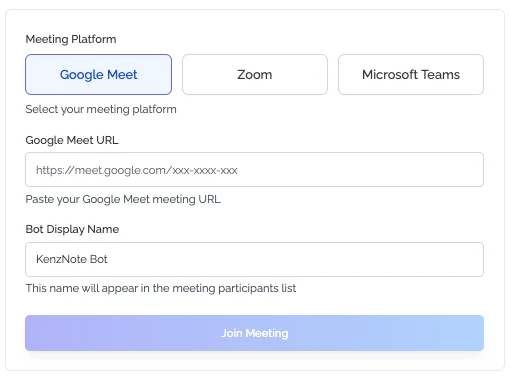 Getting started: Paste a Zoom, Google Meet, or Teams link and KenzNote joins the call automatically. No calendar access needed.
You do not need a $70,000 platform to start using conversation intelligence on your sales calls. Here is a practical path for SMB sales teams:
Step 1: Start recording and transcribing every sales call
You cannot analyze what you do not capture. Start here. Use KenzNote ($0.99/meeting) or Fireflies to get transcripts of your calls today. No contract, no calendar sync required.
Step 2: Review calls with your team weekly
Pick two or three calls per week to review together. Look at the transcript. Where did the conversation go well? Where did the rep lose momentum? What questions did they ask, or fail to ask? You can do this manually before you invest in analytics features.
Step 3: Track a few metrics manually
You do not need a platform to track talk-to-listen ratio. Listen to a few calls and estimate it. Count the questions asked. Note which objections came up. Build a simple spreadsheet and look for patterns over four to six weeks.
Step 4: Build a library of great calls
Tag and save calls that went particularly well: a closed deal, a strong discovery call, an excellent objection-handling moment. This becomes your training library for new reps, far more valuable than any generic onboarding deck.
Step 5: Upgrade when you have outgrown the basics
If you are scaling past 10 reps and spending significant time manually reviewing calls, that is when a dedicated conversation intelligence platform starts to pay for itself. By then, you will know exactly what features you need and whether the ROI justifies the cost.
Use Cases: Where Conversation Intelligence Delivers the Most Value
 Topic detection: Key themes from every call surface automatically, from pricing discussions to competitor mentions.
Sales coaching
The most immediate use case. Managers can stop relying on memory or cherry-picked self-reporting from reps. They review real calls, leave timestamped comments, and coach on specific moments rather than vague impressions.
New rep onboarding
Give new hires a curated library of calls: top discovery conversations, successful objection handling, deal-closing moments. Reps learn faster from real examples than from role-play or training videos.
Deal reviews
When a deal is stuck or going cold, review the last two or three calls. Was there an unresolved objection? Did the prospect mention a competitor that never got addressed? Conversation intelligence gives context that CRM notes rarely capture.
Competitive intelligence
Aggregate competitor mentions across all calls. Which competitors come up most? In which stages? What concerns do prospects raise about them? This data shapes your competitive positioning and battlecards.
Handoffs between SDR and AE
When an SDR passes a qualified lead to an AE, the AE can listen to the discovery call instead of relying on a summary in the CRM. They walk into the first meeting already knowing the prospect's pain points, language, and concerns.
Voice of customer for marketing
The exact language prospects use to describe their problems is marketing gold. Conversation intelligence captures it at scale, feeding better copy, better case studies, and better content.
KenzNote: 80% of the Value at 1% of the Cost
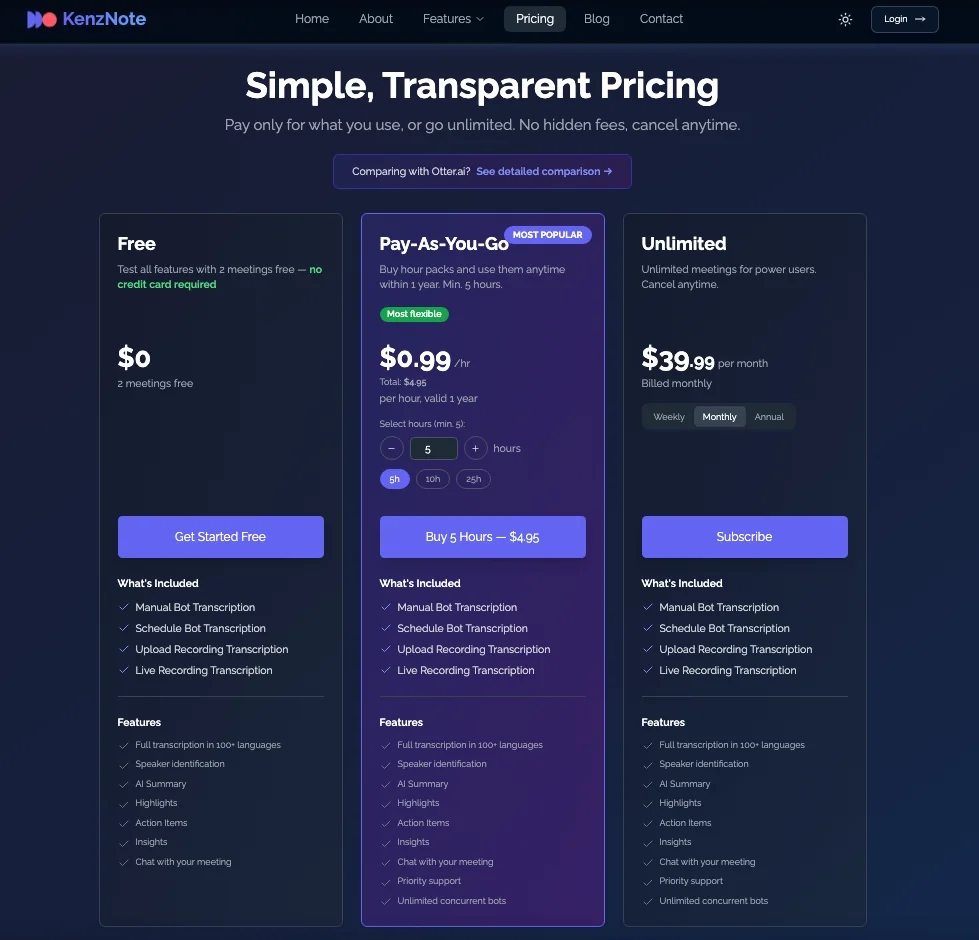 Pay only for what you use: $0.99 per meeting, no subscription, no minimum commitment.
KenzNote is an AI meeting notes app built for teams that need accurate transcripts and summaries without the complexity or cost of enterprise platforms.
At $0.99 per meeting, you pay only for what you use. There is no subscription to justify, no minimum seats, no calendar access required. You upload or connect your Zoom, Google Meet, or Teams call, and you get back a clean transcript with speaker labels, an AI-generated summary, and action items.
For a sales team running 20 discovery calls per month, that is $19.80, not $1,400 per user per year. You will not get Gong's deal risk scoring or pipeline analytics. But you will get a searchable record of every sales conversation, AI summaries your reps can review in minutes, and a foundation for building a coaching culture without waiting for budget approval.
If you are a sales manager who has been curious about conversation intelligence but assumed it was out of reach, start here. You can try KenzNote on your next call for less than a dollar.
Frequently Asked Questions
What is conversation intelligence software?
Conversation intelligence software records, transcribes, and analyzes sales calls using AI. It goes beyond simple recording by identifying patterns in how conversations unfold: who talks most, what objections come up, how prospects respond, and turning those patterns into coaching data for sales teams.
How is conversation intelligence different from call recording?
Basic call recording just stores audio. Conversation intelligence adds AI analysis on top: transcription, speaker identification, sentiment tracking, talk-to-listen ratio, objection detection, and topic tagging. The goal is not just to have a record but to extract actionable insights from every conversation.
What is a good talk-to-listen ratio for sales calls?
Research from multiple conversation intelligence platforms consistently shows that top-performing sales reps talk approximately 40 to 46% of the time on calls and let prospects speak the remaining 54 to 60%. Discovery calls where reps listen more tend to generate better qualification data and higher close rates.
Do I need Gong or Chorus to get started with conversation intelligence?
No. Gong and Chorus are excellent tools for large sales organizations with enterprise budgets, but they are not necessary to start. Tools like KenzNote ($0.99/meeting) and Fireflies give you transcripts and AI summaries: the core building blocks, without the contract or the cost. Most SMB sales teams can start there and only evaluate enterprise tools when they have outgrown the basics.
Is conversation intelligence legal? Can I record sales calls without permission?
Recording laws vary by jurisdiction. In the United States, one-party consent states allow recording as long as one person on the call (typically the rep) consents. Two-party consent states, including California, require all parties to consent. Most conversation intelligence tools auto-announce recording at the start of a call. Always consult your legal team and disclose recording to prospects before starting. Many sales teams include a recording notice in their meeting invites.
How much does conversation intelligence software cost?
It depends heavily on the tier. Enterprise platforms like Gong run $1,200 to $1,600 per user per year with minimum contract sizes that often push total annual cost above $70,000. Mid-tier tools like Fireflies start around $10/user/month. KenzNote offers a pay-per-use model at $0.99 per meeting with no subscription and no minimum commitment.
What platforms does conversation intelligence software work on?
Most tools support Zoom, Google Meet, and Microsoft Teams. Some enterprise tools also cover Webex and other platforms. KenzNote works on Zoom, Google Meet, and Teams. Check compatibility with your specific meeting stack before committing to any tool.
Can conversation intelligence replace sales managers?
No, and it should not. Conversation intelligence gives managers better data and more efficient coaching workflows, but the human judgment of an experienced sales leader is irreplaceable. The best use of these tools is to free managers from the tedious work of manually reviewing calls so they can spend more time on actual coaching conversations.
Related Resources
- Meeting Notetaker for Sales Teams: AI-Powered Call Intelligence
- Fireflies.ai vs Otter.ai: Which Is Right for You in 2026?
- Best AI Meeting Note Taker Apps 2026
- Is It Legal to Record Meetings? State-by-State Guide
- AI Follow-Up Email After a Meeting: Complete Guide
- Best AI Transcription Services 2026
Ready to Capture Every Sales Call?
Stop letting insights slip through manual note-taking. Let KenzNote handle the transcript while you focus on closing.
Start with KenzNote:
- 1 meeting free to try (no credit card)
- $0.99 per meeting after (or $29.99/month unlimited)
- No calendar access required: paste your meeting link when ready
- Works on Zoom, Google Meet, and Microsoft Teams
- Transcript and AI summary delivered within minutes

About KenzNote Team
The KenzNote team is dedicated to helping teams capture better meeting insights and transform how they collaborate. With backgrounds in AI, product design, and enterprise software, we're building the future of meeting productivity.
Ready to transform your meetings?
KenzNote automatically captures meeting insights, extracts action items, and generates summaries so you can focus on the conversation instead of taking notes.
Try KenzNote Free