
Quick Answer
For multilingual teams, the best AI meeting notetaker in 2026 is the one that supports your specific language combination with documented accuracy, handles code-switching gracefully rather than failing silently, and gives you control over which language to transcribe in. tl;dv is currently the strongest option for teams that work primarily in non-English European languages. KenzNote and Otter handle a wide range of languages with solid English-dominant performance. Fireflies offers broad language support but uneven accuracy outside English.
No single tool is the best for every language. Check the specific language support table in this guide before committing.
Key Takeaways
- Transcription accuracy for non-English languages is often 10-20 percentage points lower than English, depending on the tool and language
- Code-switching (switching between languages mid-conversation) is handled poorly by most tools; few handle it reliably
- Language-specific features like proper nouns, honorifics, and punctuation conventions vary significantly by tool
- tl;dv has the strongest support for non-English European languages with documented accuracy figures
- Most tools default to detecting the dominant language; in mixed-language meetings this can cause entire segments to be mistranscribed
- Accent handling is distinct from language support; even within English, accuracy varies significantly by regional accent
- Practical workarounds exist to improve accuracy in multilingual meetings
Table of Contents
- Why Multilingual Teams Need Special Consideration
- How AI Transcription Handles Multiple Languages
- Code-Switching: The Hardest Problem
- Accent Handling
- Language Support Comparison Table
- Tool-by-Tool Breakdown
- Tips for Improving Accuracy in Non-English Meetings
- Which Tool Should You Choose
- Frequently Asked Questions
- Related Resources
Global teams face a transcription problem that English-only teams never encounter: the tools that work perfectly in English often perform inconsistently, sometimes embarrassingly, in Spanish, French, Japanese, Arabic, and most other languages. The marketing pages all say "supports X languages," but the gap between "supported" and "accurate" is wide and rarely disclosed.
This guide is written for teams that actually work in multiple languages. It covers how AI transcription works across languages, where the current tools succeed and fail, and how to get better results from whatever tool you choose.
Why Multilingual Teams Need Special Consideration
Most AI meeting notetakers were built with English as the primary language and added other languages later, often by plugging into the same underlying speech recognition model rather than training language-specific models with equivalent depth.
The practical consequences:
- Transcription accuracy in non-English languages is frequently lower than in English, sometimes significantly so
- Summaries and action item extraction may be generated in the wrong language or produce grammatically awkward output
- Language detection can fail mid-meeting if participants switch languages, causing portions of the transcript to be attributed to the wrong language
- Proper nouns, brand names, and technical terms that are common in one language's business context may be consistently mistranscribed
For a Spanish-speaking team in Mexico City, a French-English bilingual team in Montreal, or a pan-Asian team switching between Mandarin and English, these are not edge cases. They are the normal meeting experience.
 AI transcription accuracy for non-English languages varies significantly by tool and language family.
How AI Transcription Handles Multiple Languages
Most modern AI transcription systems use a combination of acoustic modeling (interpreting the sounds of speech) and language modeling (predicting likely word sequences based on context). The language model is where English tools have a significant advantage: they have been trained on vastly more English text and speech data than any other language.
When you submit audio in French, the tool needs to:
- Detect that the language is French (not always reliable)
- Apply a French acoustic model to interpret the sounds
- Apply a French language model to predict likely words and phrases
- Generate the transcript in French with correct spelling and punctuation
- Run AI summary and action item extraction in French (or translate first, which introduces errors)
Each step introduces potential failure. Tools that handle this pipeline well for a specific language have invested in building and validating each component for that language. Tools that "support" a language but have not invested in language-specific quality produce poor results even on clear audio.
The best indicator of real language support is published accuracy figures for each language, verified with sample audio. Most vendors do not publish these figures, which is itself informative.
Code-Switching: The Hardest Problem
Code-switching refers to shifting between two or more languages within a single conversation. It is extremely common in bilingual and multilingual business environments: a Spanish-English bilingual team in Miami, a French-Dutch bilingual team in Brussels, a Mandarin-English tech team in Singapore.
Almost no current AI meeting tool handles code-switching well. The standard behavior is:
- The tool detects the dominant language at the start of the session
- It applies that language model throughout
- When a speaker switches to the other language, the output becomes garbled, phonetically transcribed, or simply wrong
Some tools attempt to detect language switches mid-transcript, but this often produces a worse result: frequent language model switches that interrupt coherent passages and misattribute sentences.
Honest assessment: if your team routinely switches languages mid-meeting, you should expect transcript errors in the switched segments regardless of which tool you use. The current state of AI transcription for code-switching is simply not reliable.
Practical workarounds for code-switching teams:
- Designate one language as the "meeting language" and encourage speakers to use it consistently
- Use separate recordings for each language segment where feasible
- Treat AI transcripts of mixed-language meetings as drafts requiring human review before distribution
Accent Handling
Accent handling is a distinct issue from language support. Within a single language, regional accents can significantly affect transcription accuracy. This is well-documented for English (British, Indian, Australian, and Caribbean English accents all affect accuracy in tools trained primarily on American English), and the same pattern applies across languages.
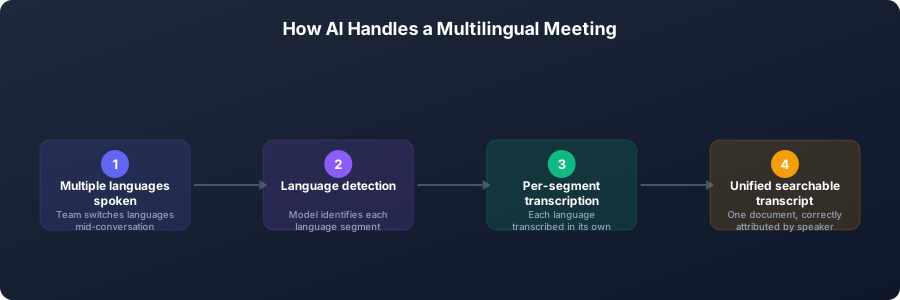 How AI notetakers detect language switches and produce one unified transcript.
Tools trained primarily on standard European Spanish, for example, may struggle with Latin American regional accents, particularly those from regions where Spanish is spoken with significant indigenous language influence. A tool that claims "Spanish support" and was validated against Castilian Spanish speakers may perform poorly for a team in Bolivia or Guatemala.
For your specific accent and dialect, the only reliable approach is to test with your own audio. Most tools offer free tiers or trials that let you upload a sample recording and evaluate the results before committing.
 Testing with your own team's actual audio is the most reliable way to evaluate transcription accuracy for your language and accent.
Language Support Comparison Table
This table reflects documented language support and general accuracy estimates based on available testing as of 2026. Accuracy figures are approximate and vary significantly by audio quality, speaker accent, and vocabulary.
| Language | Otter.ai | Fireflies.ai | tl;dv | KenzNote |
|---|---|---|---|---|
| English | Excellent | Excellent | Excellent | Excellent |
| Spanish | Good | Good | Very Good | Excellent |
| French | Good | Good | Very Good | Excellent |
| German | Fair | Good | Very Good | Excellent |
| Portuguese | Fair | Good | Good | Excellent |
| Italian | Fair | Fair | Good | Excellent |
| Dutch | Limited | Fair | Good | Excellent |
| Japanese | Fair | Fair | Fair | Good |
| Mandarin | Fair | Fair | Fair | Good |
| Korean | Limited | Fair | Fair | Good |
| Arabic | Limited | Limited | Limited | Excellent |
| Hindi | Fair | Fair | Limited | Good |
| Russian | Fair | Fair | Fair | Excellent |
| Swedish | Limited | Limited | Good | Excellent |
| Polish | Limited | Limited | Good | Excellent |
| Turkish | Limited | Limited | Good | Excellent |
| Kazakh | Limited | Limited | Good | Excellent |
| Greek | Limited | Limited | Good | Excellent |
| Czech | Limited | Limited | Good | Excellent |
| Azerbaijani | Limited | Limited | Good | Excellent |
Key: Excellent = 90%+ accuracy on clear audio; Very Good = 85-90%; Good = 78-85%; Fair = 65-78%; Limited = below 65% or not officially supported
Note: These are general estimates. Accuracy varies by speaker, topic, audio quality, and vocabulary. Always test with your own audio before committing to a tool.
Tool-by-Tool Breakdown
tl;dv is the strongest option for European language teams. The company has invested specifically in non-English language support and publishes more language-specific documentation than its competitors. It supports over 30 languages with better-than-average accuracy for French, German, Spanish, Dutch, Polish, and Scandinavian languages. For teams in Europe where non-English meetings are common, tl;dv is worth evaluating seriously. See our tl;dv review for more detail.
Otter.ai performs well in English and handles Spanish and French adequately for most business purposes. Its language detection is reasonably reliable for single-language meetings. Code-switching is not a strength. For teams where English is the primary language with occasional non-English segments, Otter works. For primarily non-English teams, accuracy limitations become more significant.
Fireflies.ai claims support for 60+ languages, which is technically true in that the underlying speech recognition can process audio in many languages. Whether the transcription is accurate enough to be useful is a different question. Fireflies performs well in English and adequately in major European languages for clear audio. For Asian languages and Arabic, results are inconsistent.
KenzNote uses high-quality underlying transcription models and performs well in English and Western European languages. It is a competitive option for teams working primarily in English or in languages where it has documented support. Its privacy-first design and pay-per-meeting pricing make it a strong choice for multilingual teams in regulated industries where data privacy is an additional concern.
For a broader evaluation of transcription quality across tools, see our guide to the best AI transcription services in 2026.
Tips for Improving Accuracy in Non-English Meetings
Regardless of which tool you choose, these practices consistently improve transcription accuracy for non-English and multilingual meetings:
Before the meeting:
- Select the correct language in your tool settings before starting; do not rely on automatic language detection
- Ask speakers to use headsets or quality microphones; background noise disproportionately affects non-English transcription
- For technical or domain-specific vocabulary, check whether your tool allows custom vocabulary additions
During the meeting:
- Speak at a measured pace; rapid speech degrades accuracy more in non-English languages than in English
- Minimize simultaneous speaking; speaker separation is harder in non-English audio
- If possible, designate one primary language for the meeting rather than switching
After the meeting:
- Review proper nouns, brand names, and technical terms carefully; these are the most common error types
- For important documents, have a bilingual team member review the transcript before it is distributed
- Provide corrections as feedback to the tool when possible; some tools use corrections to improve future accuracy for your account
Which Tool Should You Choose
For primarily non-English European teams: tl;dv has the best language support for French, German, Spanish, Dutch, and Scandinavian languages. Start here if your team works primarily in any of these languages.
For English-dominant teams with some non-English participants: KenzNote, Otter, or Fireflies all perform adequately. Choose based on privacy requirements and pricing model rather than language support.
For Asian language teams (Mandarin, Japanese, Korean): No major Western AI meeting tool performs particularly well in Asian languages today. All of them claim support; none of them have reached the accuracy levels that English-language users take for granted. Consider specialized transcription tools built specifically for your language, or use AI meeting tools for English portions only.
For bilingual code-switching teams: No current tool handles this reliably. Use any tool that supports your primary language, treat switched-language segments as requiring human review, and be realistic about what the transcript will capture.
To learn more about how AI meeting assistants work in general, including how to evaluate them, see our guide to what an AI meeting assistant actually is. To get started with KenzNote, see the getting started guide.
Frequently Asked Questions
Which AI meeting notetaker is best for Spanish-speaking teams?
tl;dv currently offers the best Spanish transcription accuracy among major AI meeting tools, with documented support for both European and Latin American Spanish. Otter and Fireflies handle Spanish adequately for meetings with clear audio and standard accents. KenzNote performs well for Spanish on clean audio. All tools struggle with regional accents and technical vocabulary; test with your own team's audio to evaluate.
Can AI meeting tools transcribe meetings where speakers switch between English and another language?
Not reliably. Code-switching is the hardest problem for current AI transcription tools. Most tools lock onto a dominant language and perform poorly when speakers switch. Some tools attempt to detect language changes mid-conversation but do so inconsistently. If code-switching is common in your meetings, expect transcript errors in the switched segments and plan for human review.
Does AI meeting transcription work for Mandarin?
Yes, but with significantly lower accuracy than English. All major AI meeting tools have weaker Mandarin support than their marketing implies. Accuracy varies widely by accent (Mandarin has four major accent groups) and whether the conversation is formal or colloquial. For critical Mandarin content, use AI transcription as a draft and have a native speaker review the result.
How do I improve AI transcription accuracy for non-English meetings?
Use headsets or quality microphones, select the correct language before starting rather than relying on auto-detection, ask speakers to pace their speech, avoid simultaneous talking, and review proper nouns and technical terms after the meeting. Custom vocabulary features, where available, can help with domain-specific terms.
Are there AI meeting tools specifically built for Asian languages?
There are specialized transcription services built for Japanese, Mandarin, and Korean that outperform general-purpose Western AI meeting tools. These are typically standalone transcription services rather than full meeting assistant platforms. For teams that work primarily in these languages, it may be worth using a specialized service for transcription and a general tool for meeting management features.
Does KenzNote support non-English meetings?
Yes, KenzNote supports transcription in multiple languages and performs well for major European languages. For the most current language support details and accuracy for your specific language, testing with a sample recording is recommended. KenzNote's pay-per-meeting pricing makes this testing inexpensive.
Related Resources
References & Citations
- [1]Most spoken languages worldwide 2024Statista. January 1, 2024https://www.statista.com/statistics/266808/the-most-spoken-languages-worldwide/
- [2]Diversity wins: How inclusion mattersMcKinsey. May 19, 2020https://www.mckinsey.com/featured-insights/diversity-and-inclusion/diversity-wins-how-inclusion-matters
- [3]The Most Common Reasons Language Barriers Persist at WorkHarvard Business Review. June 1, 2021https://hbr.org/2021/06/research-how-cultural-differences-can-impact-global-teams
All external sources have been reviewed for accuracy and relevance. Last verified: September 2026.

About KenzNote Team
The KenzNote team is dedicated to helping teams capture better meeting insights and transform how they collaborate. With backgrounds in AI, product design, and enterprise software, we're building the future of meeting productivity.
Ready to transform your meetings?
KenzNote automatically captures meeting insights, extracts action items, and generates summaries so you can focus on the conversation instead of taking notes.
Try KenzNote Free