
Quick Answer
AI meeting notes can be used safely for board meetings and investor calls, but only when the tool offers contractual data privacy guarantees, granular access controls, and never trains its AI on your content. Standard transcription tools that use your data to improve their models are not appropriate for privileged, confidential, or legally sensitive discussions. Choose a privacy-first tool and configure access controls carefully before any high-stakes meeting.
Key Takeaways
- Board minutes are legal records; AI tools can help draft them but a human must review and certify the final version
- Attorney-client privilege can be waived if privileged communications are shared with third-party AI services that retain and process the data
- Investor call transcripts stored in cloud tools may trigger NDA obligations if the tool's terms allow data use for model training
- Access control matters as much as the tool itself: restrict who can view, export, and share transcripts
- Privacy-first AI tools with contractual no-training guarantees are the only appropriate choice for board-level use
- Data residency requirements apply to international boards; verify where your transcripts are stored
Table of Contents
- Why Board Meetings Are Different
- Attorney-Client Privilege and AI Transcription
- Investor Call Confidentiality
- Board Governance Records: Legal Requirements
- Access Control: Who Can See What
- Data Residency for International Boards
- How to Evaluate an AI Tool for Board Use
- KenzNote for High-Stakes Meetings
- Frequently Asked Questions
- Related Resources
Board meetings and investor calls are not like ordinary standups or project syncs. The conversations happening in these rooms carry legal weight, fiduciary responsibility, and confidentiality obligations that don't exist elsewhere in the organization. A careless choice of AI transcription tool can expose privileged communications, trigger NDA violations, and create governance liabilities that outlast the meeting itself.
This guide covers the specific risks you need to understand before deploying AI meeting notes at the board level, and how to mitigate them properly.
Why Board Meetings Are Different
Most knowledge workers use AI notetakers to save time and reduce the cognitive load of note-taking. Those are reasonable goals. But at the board level, the stakes change substantially.
Board minutes are legal documents. In most jurisdictions, corporations are required by law to maintain accurate minutes of board meetings. These records can be subpoenaed in litigation, reviewed by regulators, and used to establish director liability. A transcript generated by an AI tool is not the same as certified minutes, and conflating the two creates legal risk.
Discussions are often privileged. When legal counsel participates in a board meeting, portions of the discussion may be protected by attorney-client privilege. That protection can be waived if the communication is shared with third parties, including AI transcription services that process and retain the content.
Investor calls carry NDA obligations. Early-stage companies routinely share material non-public information with investors and prospective investors under NDA. If that conversation is transcribed and stored on a third-party platform, the NDA analysis becomes complicated quickly.
The consequences of a breach are severe. A leaked board discussion about an acquisition, a fundraising round, or a board-level personnel matter can cause real damage: securities law exposure, deal collapse, or litigation.
This does not mean AI tools cannot be used at the board level. It means you need to be more careful about which tool you choose and how you configure it.
 Board minutes are legal records. AI can assist in drafting them, but a human must review and certify the final document.
Attorney-Client Privilege and AI Transcription
Attorney-client privilege protects confidential communications between an attorney and their client for the purpose of legal advice. The key word is confidential: if you share a privileged communication with a third party, you may waive the privilege, making that communication discoverable in litigation.
When you use an AI transcription service to record a board meeting where outside counsel is present and providing legal advice, you are potentially sharing privileged communications with that service. Whether this constitutes a waiver depends on the specific jurisdiction, the terms of service of the tool, and whether the disclosure was "reasonably necessary."
The safest position is to treat any AI tool that retains, processes, or trains on your data as a potential third party for privilege purposes. This means:
- Read the terms of service carefully. Does the vendor retain your transcripts? For how long? Can they use the content?
- Look for contractual, not just policy-based, guarantees that your data will not be used for training or retained beyond your account
- Consult with legal counsel before using any AI transcription tool in meetings where privileged communications occur
See our guide on AI meeting assistants and data training for a detailed breakdown of how different vendors handle your content.
Investor Call Confidentiality
Investor calls at the Series A stage and beyond often involve sharing financial projections, product roadmaps, and strategic plans that are explicitly covered by NDAs. Here is what most companies overlook: the NDA governs how the receiving party handles the information, but it does not address what happens when the disclosing party introduces a third-party tool into the conversation.
If you invite an AI bot into an investor call, you are introducing a system operated by a third company into a confidential discussion. Questions that arise:
- Does your NDA allow you to share covered information with third-party service providers?
- Does the AI vendor's terms of service grant them any rights to your content?
- If the vendor experiences a data breach, what is your exposure under the NDA?
These questions do not have universal answers. They depend on your specific NDA language and the vendor's terms. But they are questions you should ask before the call, not after.
The most defensible position: use a tool with a contractual guarantee that your data is never retained beyond your session or used for any purpose other than serving your account.
Board Governance Records: Legal Requirements
Corporate law in most jurisdictions requires that corporations maintain minutes of board meetings. These requirements vary by jurisdiction, but common elements include:
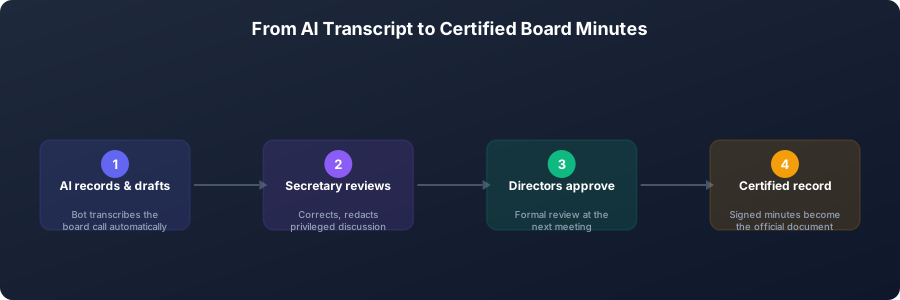 An AI transcript is a drafting aid, not the official record, until a human reviews and certifies it.
- A record of who attended the meeting
- The date, time, and location
- Resolutions passed and how each director voted
- Material discussions that led to significant decisions
AI-generated transcripts are useful raw material for drafting minutes, but they are not themselves valid board minutes. The transcript captures everything said; formal minutes capture what was decided and who decided it. These are different documents with different legal functions.
A practical workflow that works at the board level:
- Use AI to transcribe the meeting and generate a draft summary
- Have the corporate secretary or general counsel review the draft against the transcript
- Draft formal minutes that include the required legal elements
- Circulate minutes for director review and approval at the next meeting
The AI tool accelerates step one. It does not replace steps two through four. For a template that covers the required elements of board minutes, see our board meeting minutes template.
 Access control and data residency settings are as important as transcription quality for board-level meetings.
Access Control: Who Can See What
Even if you choose a privacy-respecting AI tool, internal access control matters enormously. A transcript of a board meeting discussing executive compensation, potential litigation, or an M&A target should not be visible to everyone in the organization.
Questions to ask before choosing a tool for board use:
- Can you restrict transcript access to specific named individuals?
- Can you prevent downloads or exports by non-administrators?
- Does the tool provide an audit log showing who accessed which recording?
- Can you set different access levels for different meeting types?
- Can transcripts be permanently deleted when no longer needed?
The principle of least privilege applies here as much as it does in information security: only the people who need access to the content should have it, and they should have it only for as long as necessary.
Data Residency for International Boards
Companies with international board members, investors, or operations face an additional layer of complexity: data residency requirements.
GDPR in the European Union imposes restrictions on transferring personal data outside the EU. If your board includes EU-based directors, or if your company processes EU personal data, a transcript of a board meeting that is stored on servers in the United States may trigger GDPR compliance obligations.
Similar rules apply in other jurisdictions, including Canada (PIPEDA), Brazil (LGPD), and China (PIPL). The regulatory landscape is not uniform, and it is changing.
What to verify before choosing a tool for international board use:
- Where are your transcripts stored? Which country, which cloud provider?
- Does the vendor offer EU-based or region-specific data storage options?
- What are the vendor's data processing agreements (DPAs)?
- Has the vendor certified under relevant international data transfer frameworks?
For boards with multinational membership, these are not theoretical questions. They are compliance obligations.
How to Evaluate an AI Tool for Board Use
When evaluating any AI transcription tool for board or investor call use, apply this checklist:
Data handling:
- Contractual guarantee (not just a policy) that your data will never be used for AI training
- Clear data retention policy with the ability to delete transcripts on demand
- No third-party data sharing without explicit consent
Security:
- SOC 2 Type II certification or equivalent
- End-to-end encryption in transit and at rest
- Access controls with role-based permissions and audit logs
Legal:
- Data processing agreement available
- Clear terms on data ownership (your data is yours)
- GDPR-compliant with regional data storage options where required
Operational:
- Works without requiring a bot to join the call (important for sensitive meetings)
- Supports manual upload of recordings made with native platform tools
- Does not require calendar access to function
For a broader discussion of recording legality, see our guide on whether it is legal to record meetings.
KenzNote for High-Stakes Meetings
KenzNote is designed with privacy as a structural feature, not a marketing claim. The key commitments that matter for board-level use:
Contractual no-training guarantee. KenzNote will never use your meeting content to train AI models. This is a contractual obligation, not just a privacy policy that can change with a terms update.
No bot joining your call. KenzNote works through native recording integrations and file uploads, which means no AI bot appears in your participant list. This matters for investor calls and board meetings where participants notice and question the presence of external tools.
Pay-per-meeting pricing. At $0.99 per meeting, you are not paying for a subscription to keep sensitive transcripts stored indefinitely on a vendor's servers. Process the meeting, get your notes, and control the retention yourself.
Meeting chat for private access. KenzNote's natural language meeting chat lets authorized users query past meeting content without distributing the full transcript. This supports the principle of least privilege by letting people ask specific questions rather than accessing the entire record.
For legal and compliance-intensive use cases, also see our guide on AI note-taking for lawyers, which covers similar privilege and confidentiality considerations.
 High-stakes meetings require tools with contractual privacy guarantees, not just favorable policy language.
Frequently Asked Questions
Can AI meeting notes replace official board minutes?
No. AI-generated transcripts and summaries are useful drafting tools, but they are not legal substitutes for certified board minutes. Board minutes must be reviewed, approved by directors, and maintained as formal corporate records. AI can dramatically reduce the time it takes to produce a draft, but a human, typically the corporate secretary or general counsel, must finalize and certify the document.
Does using an AI transcription service waive attorney-client privilege?
It can, depending on the jurisdiction, the specific communications involved, and the vendor's data practices. The risk is highest when the vendor retains transcripts and uses them for purposes beyond serving your account. Using a tool with a contractual no-retention and no-training guarantee reduces this risk, but you should consult legal counsel for any specific matter where privilege is in question.
What should I look for in the terms of service of an AI meeting tool before using it for investor calls?
Look for: who owns the content (you should), whether the vendor can use your data for training (they should not), how long data is retained and whether you can delete it, and whether the vendor has a data processing agreement available for GDPR compliance. If the terms are vague or grant the vendor broad rights to your content, that is a red flag for confidential use cases.
Is it legal to record board meetings?
In most jurisdictions, yes, provided all participants consent. Most states follow either one-party consent or all-party consent rules for recordings. At the board level, it is standard practice to obtain explicit consent from all directors before recording any session, which is typically addressed in the meeting notice or at the start of the meeting. See our full guide on recording meeting legality for jurisdiction-specific details.
How should access to board meeting transcripts be restricted?
Apply the principle of least privilege: only individuals with a legitimate need to review the transcript should have access. Typically, this means the board chair, corporate secretary, general counsel, and any directors who request access. Transcripts of executive session (where management is excluded) should have an even more restricted access list. Verify that your AI tool supports named-user access restrictions and provides an audit log.
Can international boards use AI meeting notes under GDPR?
Yes, but it requires due diligence. The AI vendor must offer a data processing agreement, and the transcript data must either be stored within the EU or transferred under a valid legal mechanism such as Standard Contractual Clauses. Verify the vendor's data residency options and request their DPA before deploying any tool for a board that includes EU-based participants or processes EU personal data.
Related Resources
References & Citations
- [1]What Makes a Board EffectiveHarvard Business Review. September 1, 2022https://hbr.org/2002/09/what-makes-great-boards-great
All external sources have been reviewed for accuracy and relevance. Last verified: October 2026.

About KenzNote Team
The KenzNote team is dedicated to helping teams capture better meeting insights and transform how they collaborate. With backgrounds in AI, product design, and enterprise software, we're building the future of meeting productivity.
Ready to transform your meetings?
KenzNote automatically captures meeting insights, extracts action items, and generates summaries so you can focus on the conversation instead of taking notes.
Try KenzNote Free